PTAB Institution Rates Remained Lower in Q2, Despite Rebound, Under Director-Led Process
Access to America Invents Act (AIA) review has become significantly constrained since early last year due to a series of changes revamping the USPTO’s substantive and procedural standards governing institution.
In March 2025, then-Acting Director Coke Morgan Stewart established an interim process under which she would decide requests for discretionary denial herself, rather than a PTAB panel doing so—applying an expanded and more restrictive set of factors based on Patent Trial and Appeal Board (PTAB) precedent. Then, in October, Director John Squires announced that he would now decide all aspects of AIA review institution himself, including discretionary considerations as well as the merits. Under that director-led process, most decisions receive summary decisions that provide little, if any, insight into the director’s rationale for denying or granting institution.
The AIA review institution rate fell dramatically over the course of 2025 as a result of these changes, and in Q4, Squires instituted trial in just 12% of the petitions that he decided under the fully director-led process. That said, the rate has since climbed: Under Squires, it rose to 26% in Q1 2026 and then to 38% in Q2.
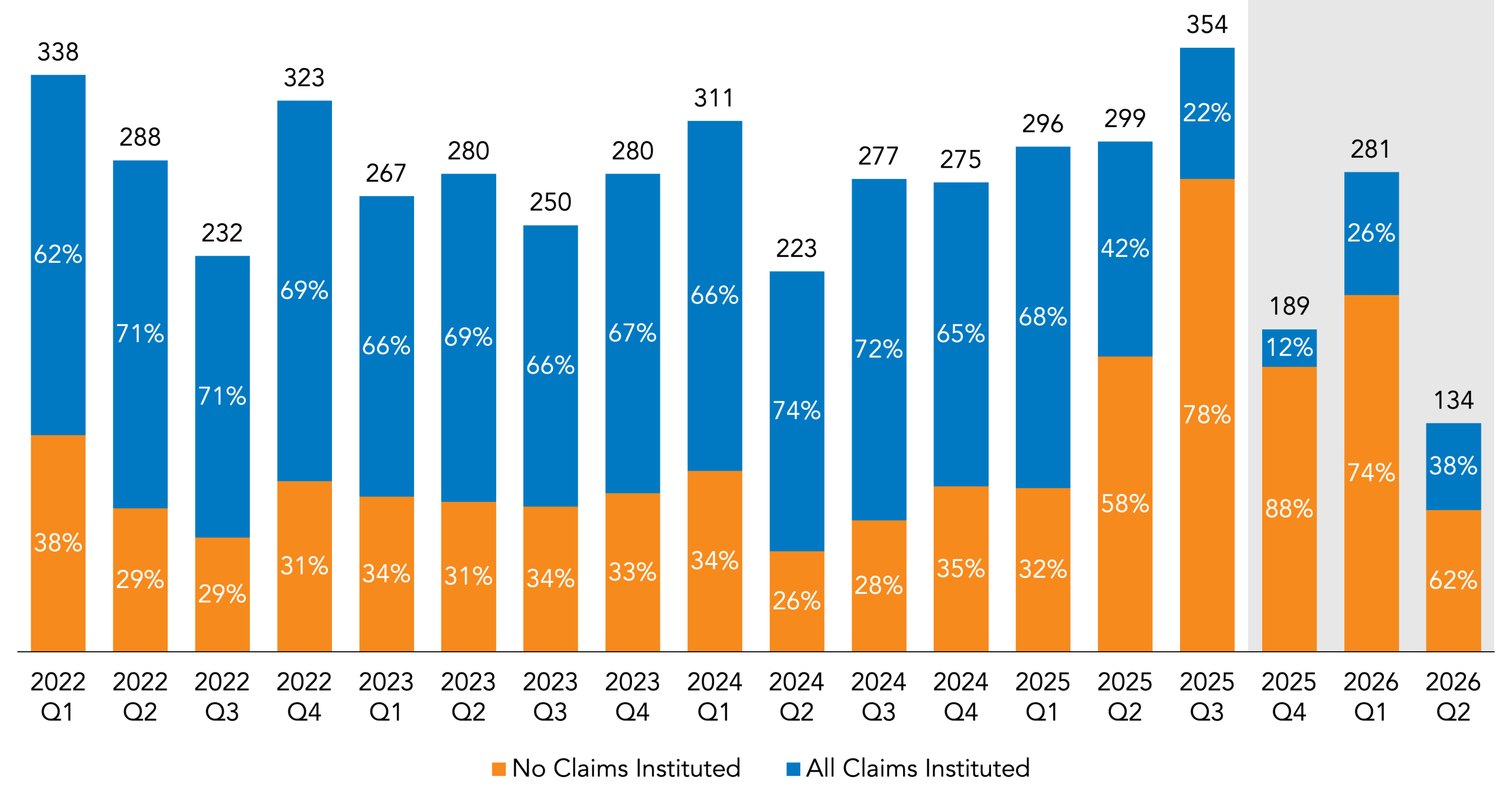
The above graph excludes institution decisions referred to PTAB panels. Including such petitions, the overall institution rate was higher at 39% in Q4, during which time a relatively larger number of referred petitions saw panel institution decisions on the merits (since, under the October process, petitions previously referred to panels would generally remain with those panels). The gap was far smaller for Q1 and Q2.
While the institution process remains far more opaque than it did under the Biden Administration, given the prevalence of summary institution decisions, Squires has since pulled back the curtain somewhat: On May 14, 2026, Squires issued a precedential decision in Magnolia Medical Technologies v. Kurin (IPR2026-00097) that outlines a set of discretionary factors underpinning his current approach, one that doubles down on prior decisions limiting AIA review when there has been parallel litigation. In Magnolia Medical, the director reiterated that his approach to institution is designed to ensure that AIA review serves as an “alternative” to district court litigation, arguing that the purpose of AIA review is to promote the “public interest” rather than the narrow “interests of private litigants”.
To that end, the decision provides a set of factors that give examples of discretionary considerations falling under that public interest standard: As detailed in various recent precedential and informative decisions, the director established that he may consider examiner error, whether there have been different claim constructions offered before the PTAB versus in parallel district court proceedings (as established in an earlier precedential decision by Squires in Revvo Technologies v. Cerebrum Sensor Technologies), whether foreign sovereigns are properly disclosed as petitioners or real parties in interest (per another precedential opinion in Tianma Electronics v. LG Display), and the parties’ “settled expectations” based on the age of a patent (as noted above).
In other decisions designated as informative, Squires has also provided similar scrutiny with respect to petitioners who assert indefiniteness arguments in district court without sufficiently justifying their pursuit of different arguments before the PTAB and has rejected subsequently proposed stipulations to withdraw those inconsistent district court arguments if the petition were instituted (see Ford Motor Company v. AutoConnect Holdings, Terumo BCT v. Haemonetics, and TikTok v. Shopsee).
Yet more notable decisions have focused on divergent validity outcomes between the PTAB and district court, based on a September 2025 memorandum requiring the PTAB to adequately justify decisions that reach a different result from the other forum. Two such decisions in late June, one issued by the Director himself and the other by a Delegated Review Panel he convened, overturned final written decisions that had invalidated patents at the heart of recent infringement verdicts—casting uncertainty over millions of dollars in damages.
See RPX’s second-quarter review for more on those changes, including their impact on filing rates for AIA reviews and ex parte reexaminations.