Judge Gilstrap Stayed on Top in Q3 2026 as Judge Albright Left the Bench
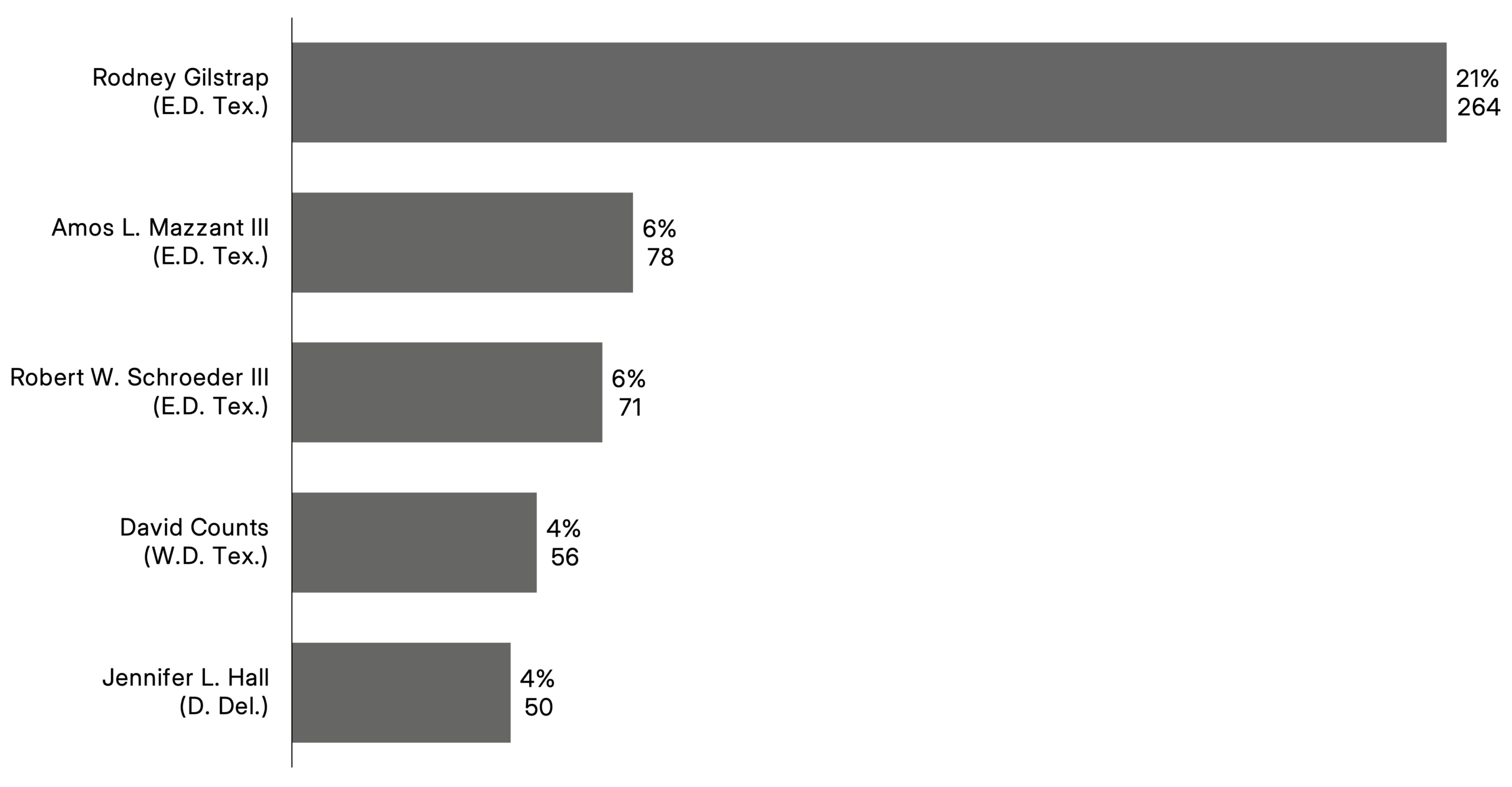
Eastern District of Texas Judge Rodney Gilstrap was once again the nation’s top patent judge, overseeing 21% of all new patent litigation in Q3 2026.
Another name is notable here for its absence: that of now-former Western District of Texas Judge Alan D. Albright, who left the bench on August 31 and has since joined the Austin, Texas office of A&O Shearman.
Judge Albright, a former (and now current) patent litigator who joined West Texas’s Waco Division in 2018, came to oversee the bulk of the nation’s patent litigation after openly seeking to attract such cases to his courtroom. This practice was enabled by a filing loophole that let plaintiffs target a specific division, thus guaranteeing that anyone filing in Waco would get Judge Albright (Waco’s only district judge).
The resulting concentration of litigation in his courtroom attracted scrutiny from both members of Congress and the federal judiciary. In 2022, an order from his district’s chief judge targeted that concentration, ordering that all Waco patent cases be randomly assigned among a larger group of judges, including Judge Albright. His patent caseload slimmed dramatically as a result.
Judge Albright also gave plaintiffs various concrete reasons to prefer his courtroom, including by establishing rules designed to streamline and speed up litigation before him as well as taking a restrictive posture toward certain types of defensive motions. In particular, he expressed a general inclination against staying cases pending the outcome of America Invents Act (AIA) reviews (citing his belief in the importance of jury trials) and a preference not to grant early patent eligibility motions under Alice (though he departed from that practice from time to time, as exemplified by a rare early Alice invalidation this past April).
However, perhaps Judge Albright’s most distinctive tendency was his handling of convenience transfer motions, which he tended to grant relatively rarely—setting a high bar for defendants seeking that relief. Judge Albright also developed an early habit of letting motions to transfer for convenience sit undecided while moving forward on claim construction and other substantive matters. This trend first drew the ire of the Federal Circuit in summer 2020, which began to issue a trickle of mandamus reversals that year that became a wave in 2021—the appellate court ordering Judge Albright, in part, not to move on to any substantive area of a case before resolving a pending motion to transfer.
That wave later subsided as Judge Albright reluctantly shifted his practices in response to the Federal Circuit’s rebukes—establishing a new “convenience transfer phase” in litigation before him that would involve a period of venue-related discovery and subsequent briefing, one that could last years. Defendants before Judge Albright meanwhile repeatedly took issue (through mandamus petitions) with how Judge Albright weighed the private and public interest factors to be considered within a convenience transfer analysis—and the Federal Circuit repeatedly stepped in to correct clear errors, often directly ordering transfer. (The appellate court did so for what is likely the last time on October 6, finding that Judge Albright’s denial of a Google motion to transfer a University of Southern California suit to the Northern District of California had been “patently erroneous” in several key respects.)
Despite adjusting his practices to comply with the aforementioned Federal Circuit rulings against him, Judge Albright continued to criticize the Federal Circuit’s interpretation of Fifth Circuit law governing transfers in Texas. In particular, he repeatedly objected to the Federal Circuit’s position that NPEs lack an interest in quickly taking cases to trial, as relevant to the public-interest factor of the transfer analysis that contemplates relative court congestion (see, e.g., here).
Though Judge Albright left a number of significant patent matters undecided upon his departure, as discussed in RPX’s coverage, he issued some notable rulings in his final weeks on the bench—including a decision in which he slashed a damage award for Katana Silicon Technologies LLC, a Longhorn IP LLC plaintiff, against Globalfoundries from $9.2M to $1M after identifying fatal evidentiary deficiencies in the plaintiff’s damages case.
Note also that as Judge Albright’s caseload fell, Western District of Texas Judge David Counts took Judge Albright’s place as the top (by volume) patent judge in the district, surpassed across the US only by Eastern District of Texas Judge Rodney Gilstrap in that regard for 2025. Judge Counts has since dipped below second place but has remained in the top five each quarter this year, holding fourth place in Q3 2026. He has adopted many of the procedures and processes formerly in place before Judge Albright.
See RPX’s third-quarter review for more on the key developments shaping patent risk in Q3.