
Q3 in Review: PTAB Institution Gets Another Revamp as Courts Weigh Pool‑Only SEP Offers
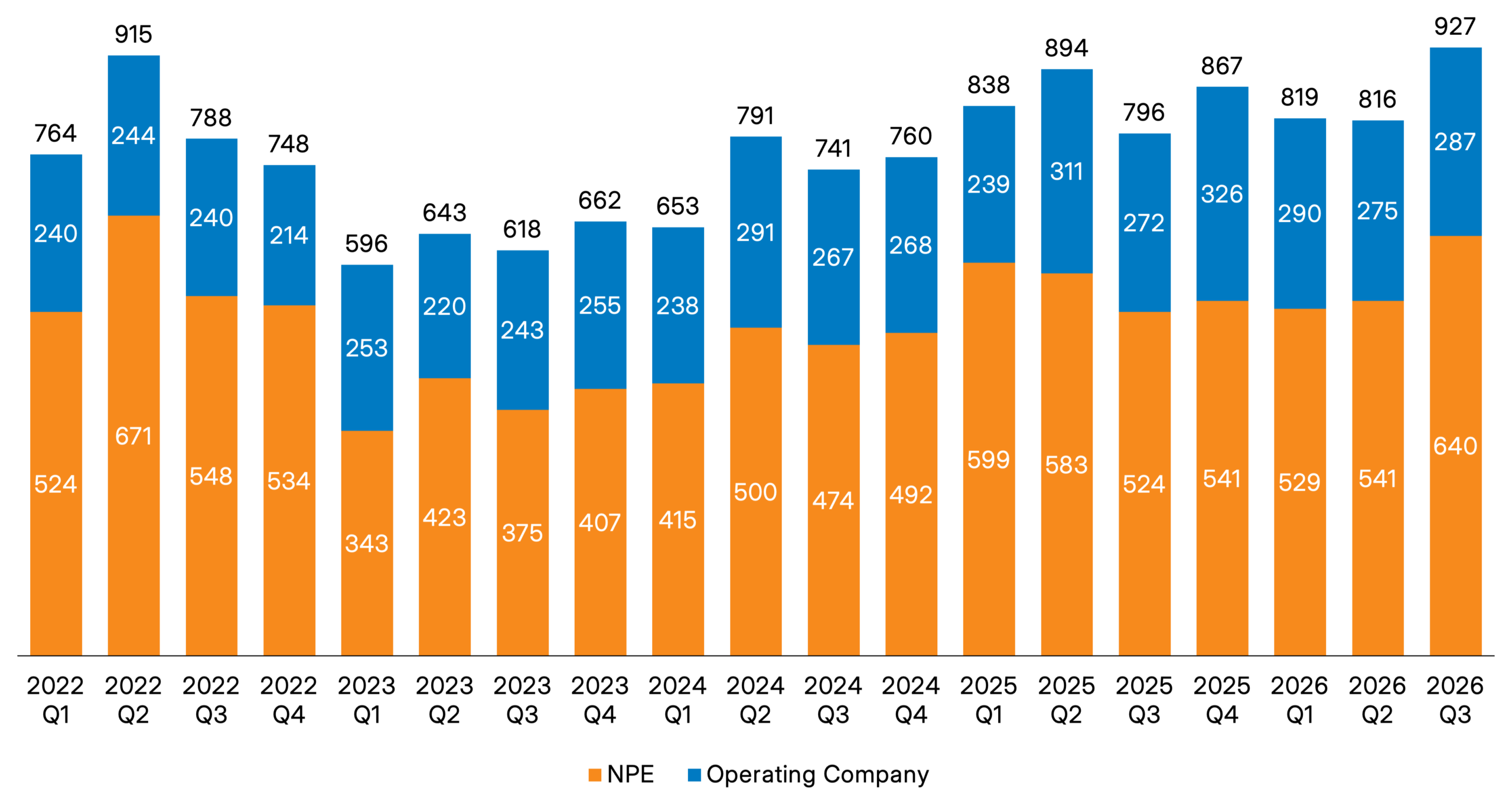
US patent litigation increased by 16% in the third quarter of 2026, with a 22% jump in NPE litigation offset by a more modest 6% uptick for operating company litigation.
USPTO Director John Squires has also revealed another procedural revamp at the Patent Trial and Appeal Board (PTAB): After taking over the entire America Invents Act (AIA) review institution process in October 2025, Squires announced that in October 2026, he plans to hand the merits portion of the institution analysis back to the PTAB while continuing to decide discretionary denials. A more sweeping rulemaking proposal to further limit the PTAB has also moved forward, as the USPTO places additional constraints on ex parte reexaminations.
Meanwhile, the EU’s Unified Patent Court (UPC) has maintained its popularity, based on filing data for the year to date, with the German local divisions continuing to dominate. In Q3, the UPC saw new filings from a variety of familiar entities focused on patent assertion, hitting high-performance computing, medtech, and cybersecurity technologies.
The standard essential patent (SEP) space also saw some notable shifts in disputes involving patent pools: During the third quarter, the UPC as well as courts in the UK and Brazil issued significant decisions ruling that SEP owners may satisfy their fair, reasonable, and nondiscriminatory (FRAND) obligations through pool offers, and allowing rate-setting claims or counterclaims targeting entire pool portfolios.
Finally, third-party litigation funding remained in the spotlight during Q3 as state legislatures, federal policymakers, and the judiciary continued to weigh new disclosure and transparency measures. Funded patent litigation also produced multiple high-profile developments, and noteworthy patent transfers highlighted ongoing activity in the patent monetization market.
RPX members will also soon have exclusive access to an on-demand RPX Community webinar covering highlights from this post; CLE credit may be available.
Litigation Update: NPE Activity Jumps in Q3
NPEs added 640 defendants to patent litigation campaigns in Q3 2026, an increase of 22% compared to Q3 2025 (when NPEs added 524 defendants). NPE litigation in the third quarter of 2026 exceeded the trailing Q3 average for 2023-2025 by 40% and was 18% higher than in the second quarter.
Meanwhile, operating company plaintiffs added 287 defendants this past quarter, a 6% increase from Q3 2025. Litigation by operating companies beat the trailing Q3 2023-2025 average by 10% and was also 4% higher than in the second quarter.
| Defendants Added | Change Compared to: | ||||
| Q3 2026 | Q3 2025 | Q3 2023-2025 Average | Q2 2026 | ||
| NPE | 640 | 22% | 40% | 18% | |
| Operating Company | 287 | 6% | 10% | 4% | |
| Total | 927 | 16% | 29% | 14% | |
Overall, patent plaintiffs added 927 defendants in the third quarter of 2026, or 16% more than in Q3 2025 and 14% more than Q2 2026, also beating the trailing average by 29%.
The operating company data above leave out another distinct category of litigation filed by a small group of design and utility patent owners targeting copycats and counterfeiters selling products online. RPX excludes such “e-seller” cases from analyses of district court litigation because they tend to follow a different dynamic compared to what one might consider the usual patent suit. These e-seller cases sometimes name hundreds of defendant entities, many of which may be merely online storefronts or aliases for the same ultimate parent. Also, plaintiffs primarily seek injunctive relief instead of damages, and their cases often end with the e-seller defendant’s failure to answer, followed by a default judgment.
This category of litigation is shown in grey below to illustrate its magnitude. As shown by the rightmost bar, e-seller litigation in Q3 2026 accounted for 312 defendants added, or 25% of all litigation during the quarter. This marks a dramatic downturn from the peak of such litigation in Q3 2024 and follows four prior quarters in which e-seller filings were far lower by defendant count (though still not nearly as low as the third quarter).
Apart from the following graph, the other analyses in this report exclude pure design patent and e-seller litigation.
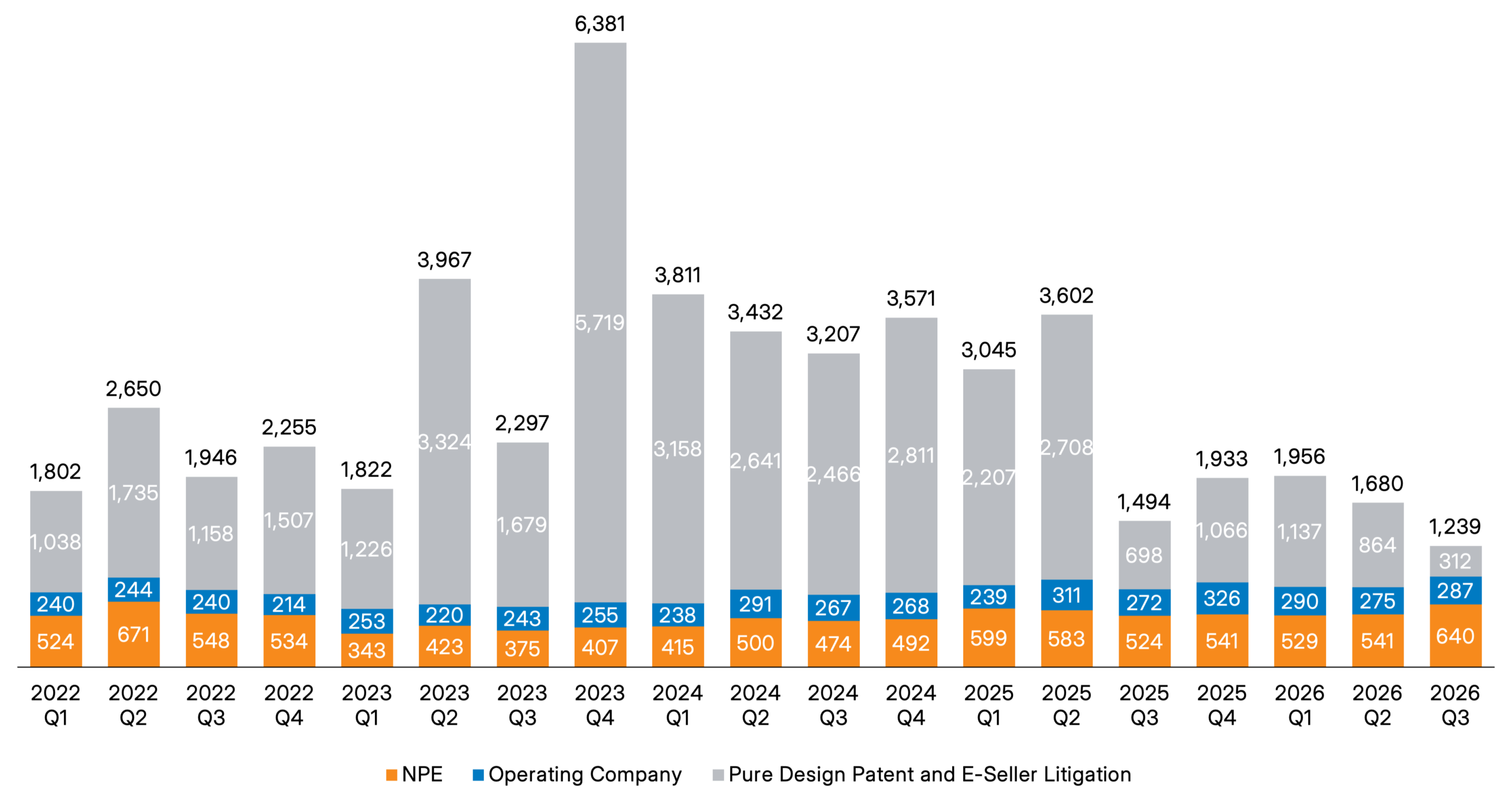
While the lower counts for the past five quarters are still subject to the caveat about defendants potentially having multiple online storefronts, as noted above, the decrease could also be related at least in part to efforts by some district judges to apply stricter procedural rules to e-seller cases, as recounted in RPX’s Q1 in Review.
However, the particularly sharp drop in Q3 is arguably most attributable to the second of two regional circuit court decisions dealing with another distinctive aspect of e-seller cases (which are also widely known as “Schedule A” actions, after the sealed exhibits used to identify defendant storefronts): service of process. Defendants located in other countries must typically be served through a central authority located in that country under the Hague Service Convention, a process that can be particularly slow when defendants are based in China. Schedule A plaintiffs have argued that provisions from the Convention allowing service by “postal channels” also allow service via email, which has become the dominant means for service in such actions.
In the past year, two circuit courts have ruled that the Convention bars service by email for defendants in China: the Second Circuit in December 2025 and the Seventh Circuit—which covers what is by far the top forum for Schedule A cases, the Northern District of Illinois—in May 2026. The timing of the latter ruling could explain the lower number of impacted storefronts in Q3, particularly since that Seventh Circuit ruling has since led to the reversal of default judgments against some improperly served Chinese e-sellers. One such company invoked the decision in an unusual class action suit that seeks to overturn numerous default judgments against Chinese defendants served by email in all Schedule A cases filed in the Northern District of Illinois.
Venue Update: Notable Verdicts in East Texas and Beyond; Judge Albright Leaves the Bench
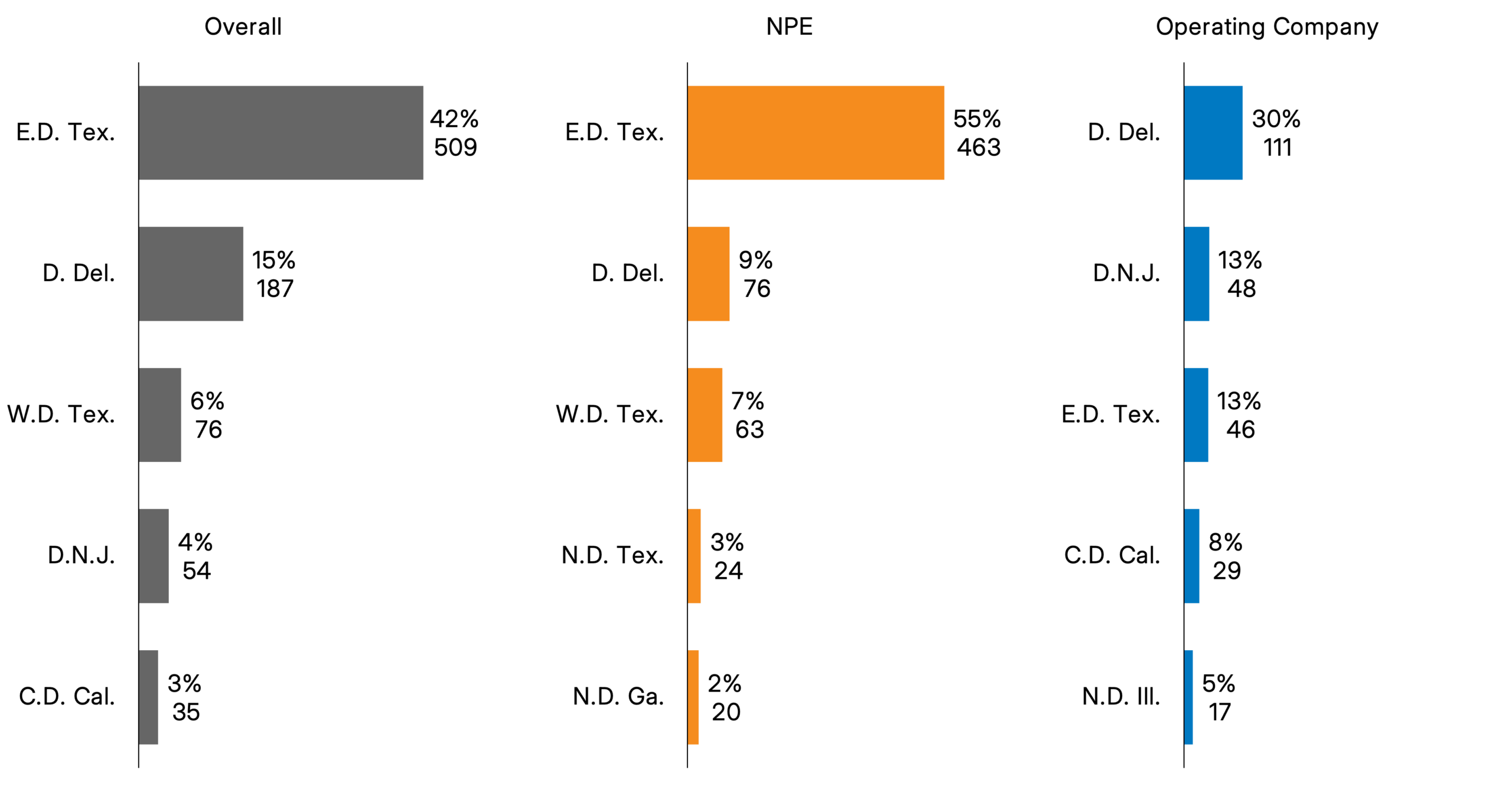
The Eastern District of Texas was the top patent district for overall litigation (i.e., with no filter for plaintiff type) and NPE litigation in Q3 2026, the venue also holding the number-three spot for operating company litigation. In second for overall litigation was the District of Delaware, which held second place for NPE litigation but was the most popular district for operating company litigation. Meanwhile, the Western District of Texas trailed behind Delaware for overall litigation and NPE litigation, taking third place for both; and failed to break the top five for operating company filings.
While East Texas accounted for the bulk of the top patent damage awards returned in Q2 2026, the rankings were more geographically diverse in the third quarter.
For instance, Q3’s largest infringement verdict by far came in the Southern District of California, not historically a patent hotspot: In that case, a jury returned a verdict for Taction Technology, Inc. in its case against Apple in late September. It awarded Taction just over $5.7B for the infringement of three claims from two patents generally related to “tactile transducers that produce bass frequency vibrations for perception by touch” via haptic features of the accused products, including certain iPhone models. The trial that produced this verdict followed a Federal Circuit reversal of a noninfringement summary judgment from District Judge Todd W. Robinson. The case—described long ago as “heavily litigated” but “run-of-the-mill”—made prior headlines over the plaintiff’s relationship with litigation funder Burford Capital. The funder has since publicly disclosed its sizable potential share of that verdict, while nonetheless cautioning that jury verdicts are frequently reduced, overturned, or resolved through settlements for amounts materially below a jury award.
Another large damage award in the third quarter came in the Western District of Texas: In mid-July, a jury there returned a verdict for Viasat, finding that Kioxia has infringed a single patent claim through the provision of certain accused controllers. The jury awarded just over $229M, characterized as a running royalty “meant only to compensate for Kioxia’s past infringement through March 30, 2026”. Viasat sued both Kioxia and Western Digital back in November 2021, both before Western District of Texas Judge Alan D. Albright, who left the bench on August 31, 2026—the Kioxia case thus marking his final plaintiff-side verdict. A stay in the case against Western Digital, imposed earlier in light of certain inter partes review (IPR) proceedings, was extended earlier this year to await the outcome of this trial. (Last August, SanDisk (SanDisk Technologies) was swapped in as the defendant in the Western Digital case.)
Yet another large Q3 damage award came in the Middle District of North Carolina, also not widely known as a patent litigation hotbed. There, a jury returned a verdict for Shoals in its district court case against Ningbo Voltage Smart Production (formed in China) and Voltage (formed in North Carolina). The jury awarded the plaintiff over $70M in lost profits and over $26M for price erosion after finding infringement of ten claims spread across two patents generally related to solar panel connectors. None of the claims were proven invalid, and the jury found willfulness here. This result follows a February 2026 final initial determination (ID) in a parallel action before the International Trade Commission (ITC), also filed back in January 2025, that ID finding a Section 337 violation by the Voltage respondents with respect to a subset of the claims tried to the North Carolina jury. These two actions follow 2023 litigation between these parties, that earlier round less successful for Shoals.
In August 2026, in litigation filed by medical diagnostics company Beckman Coulter against Cytek Biosciences, a Delaware jury found that Cytek had not infringed three tried claims and had shown them to be invalid, but that it had infringed a fourth claim through the provision of flow cytometers and cell sorters used to analyze single-cell blood and tissue samples. The jury awarded $20M in lost profit damages and a reasonable royalty of $36.11M.
Despite these verdicts elsewhere, East Texas did see its share of jury results. On September 17, 2026, a jury found six claims from four 3D printer patents infringed and not proven invalid and awarded plaintiff Stratasys $27.6M in damages from defendant Shenzhen Tuozhu Technology Co. Ltd. (Bambu Lab and other subsidiaries). A few days later, the PTAB entered final written decisions in which some but not all of the claims found infringed were canceled. This one-two adds to a growing list of seemingly inconsistent validity determinations between district court juries and PTAB panels, as covered here (and discussed in the “PTAB Update” section below).
Eastern District of Texas Judge Rodney Gilstrap presided over that jury trial. Judge Gilstrap was once again the nation’s top patent judge, overseeing 21% of all new patent litigation in Q3.
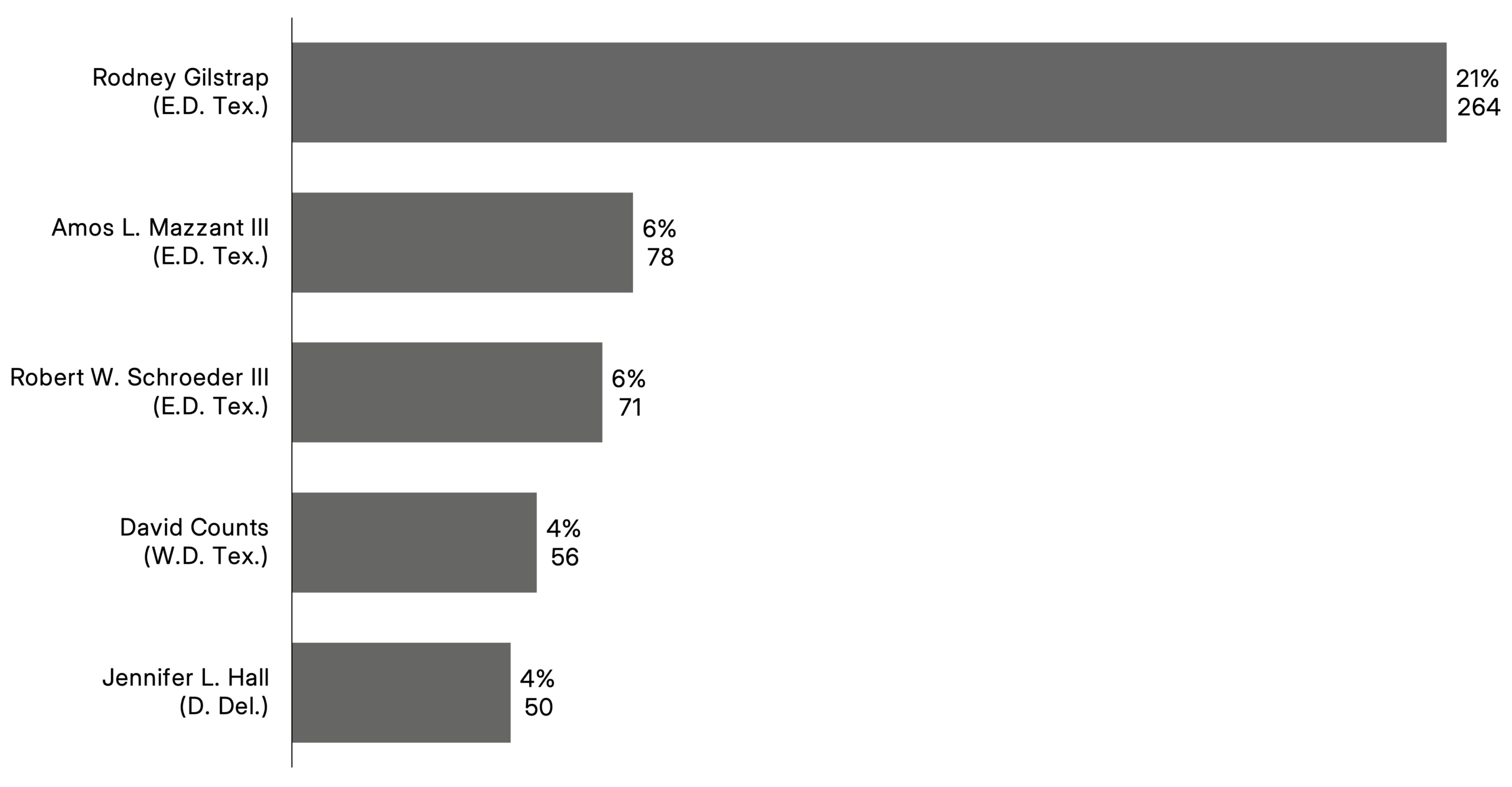
Another name is notable here for its absence: that of now-former Judge Albright, who left the bench on August 31 and has since joined the Austin, Texas office of A&O Shearman.
Judge Albright, a former (and now current) patent litigator who joined West Texas’s Waco Division in 2018, came to oversee the bulk of the nation’s patent litigation after openly seeking to attract such cases to his courtroom. This practice was enabled by a filing loophole that let plaintiffs target a specific division, thus guaranteeing that anyone filing in Waco would get Judge Albright (Waco’s only district judge).
The resulting concentration of litigation in his courtroom attracted scrutiny from both members of Congress and the federal judiciary. In 2022, an order from his district’s chief judge targeted that concentration, ordering that all Waco patent cases be randomly assigned among a larger group of judges, including Judge Albright. His patent caseload slimmed dramatically as a result.
Judge Albright also gave plaintiffs various concrete reasons to prefer his courtroom, including by establishing rules designed to streamline and speed up litigation before him as well as taking a restrictive posture toward certain types of defensive motions. In particular, he expressed a general inclination against staying cases pending the outcome of America Invents Act (AIA) reviews (citing his belief in the importance of jury trials) and a preference not to grant early patent eligibility motions under Alice (though he departed from that practice from time to time, as exemplified by a rare early Alice invalidation this past April).
However, perhaps Judge Albright’s most distinctive tendency was his handling of convenience transfer motions, which he tended to grant relatively rarely—setting a high bar for defendants seeking that relief. Judge Albright also developed an early habit of letting motions to transfer for convenience sit undecided while moving forward on claim construction and other substantive matters. This trend first drew the ire of the Federal Circuit in summer 2020, which began to issue a trickle of mandamus reversals that year that became a wave in 2021—the appellate court ordering Judge Albright, in part, not to move on to any substantive area of a case before resolving a pending motion to transfer.
That wave later subsided as Judge Albright reluctantly shifted his practices in response to the Federal Circuit’s rebukes—establishing a new “convenience transfer phase” in litigation before him that would involve a period of venue-related discovery and subsequent briefing, one that could last years. Defendants before Judge Albright meanwhile repeatedly took issue (through mandamus petitions) with how Judge Albright weighed the private and public interest factors to be considered within a convenience transfer analysis—and the Federal Circuit repeatedly stepped in to correct clear errors, often directly ordering transfer. (The appellate court did so for what is likely the last time on October 6, finding that Judge Albright’s denial of a Google motion to transfer a University of Southern California suit to the Northern District of California had been “patently erroneous” in several key respects.)
Despite adjusting his practices to comply with the aforementioned Federal Circuit rulings against him, Judge Albright continued to criticize the Federal Circuit’s interpretation of Fifth Circuit law governing transfers in Texas. In particular, he repeatedly objected to the Federal Circuit’s position that NPEs lack an interest in quickly taking cases to trial, as relevant to the public-interest factor of the transfer analysis that contemplates relative court congestion (see, e.g., here).
Though Judge Albright left a number of significant patent matters undecided upon his departure, as discussed in RPX’s coverage, he issued some notable rulings in his final weeks on the bench—including a decision in which he slashed a damage award for Katana Silicon Technologies LLC, a Longhorn IP LLC plaintiff, against Globalfoundries from $9.2M to $1M after identifying fatal evidentiary deficiencies in the plaintiff’s damages case.
Note also that as Judge Albright’s caseload fell, Western District of Texas Judge David Counts took Judge Albright’s place as the top (by volume) patent judge in the district, surpassed across the US only by Eastern District of Texas Judge Rodney Gilstrap in that regard for 2025. Judge Counts has since dipped below second place but has remained in the top five each quarter this year, holding fourth place in Q3 2026. He has adopted many of the procedures and processes formerly in place before Judge Albright.
Market Sector Update: Plaintiffs Linked to Familiar Monetization Firms and Individuals, Inventors, and a University Hit E-Commerce and Software Sector in Q3
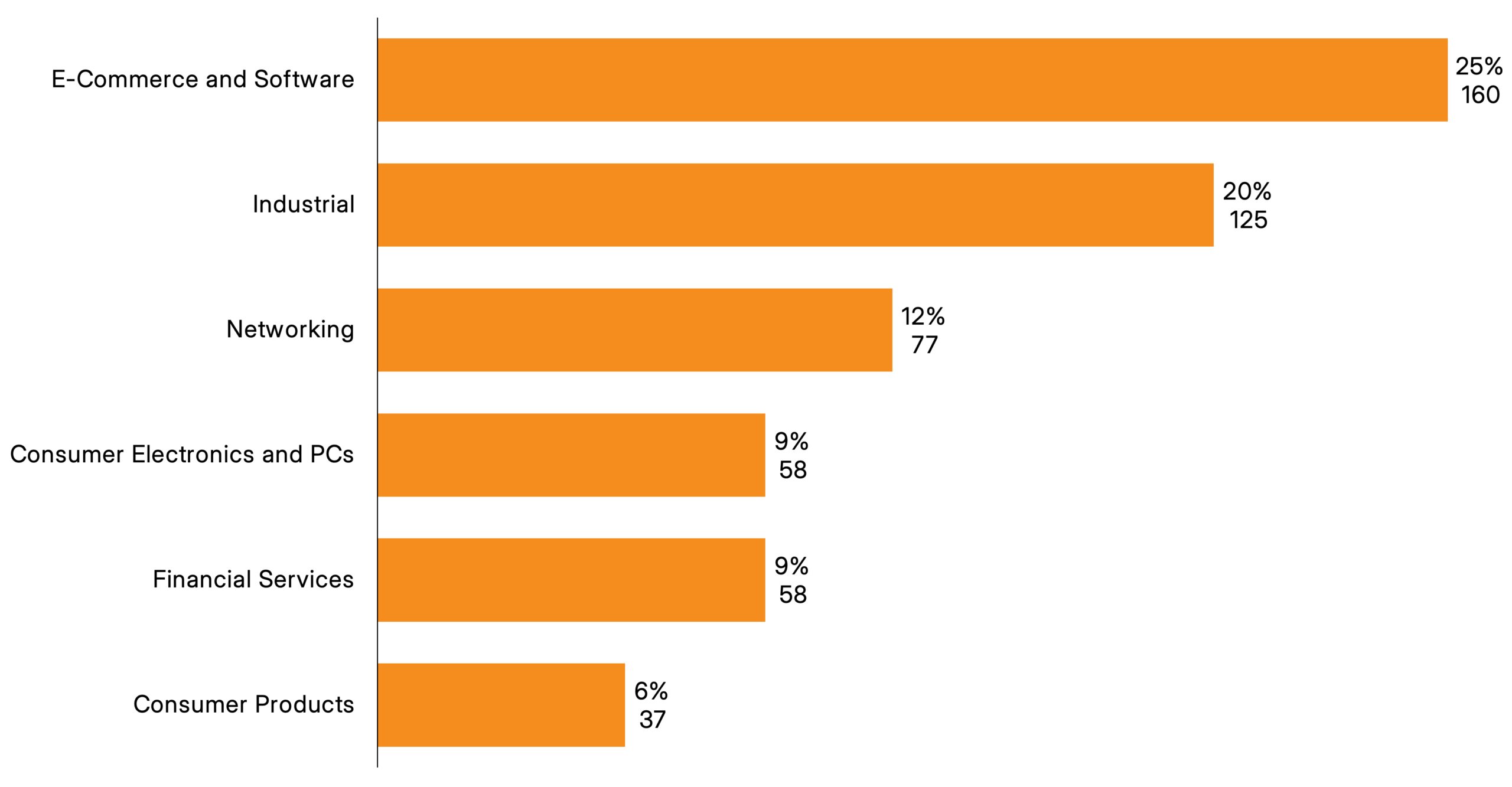
The top market sector for NPE litigation in Q3 2026 was E-Commerce and Software, accounting for 25% of the defendants added to patent litigation campaigns during the quarter. Industrial saw the second highest amount of NPE litigation in Q3, followed by Networking, Consumer Electronics and PCs and Financial Services (which tied for fourth place), and Consumer Products.
Among the NPEs hitting E-Commerce and Software in Q3 were a variety of plaintiffs connected to patent monetization firms. For example, Many Worlds 2T Innovations LLC, an entity associated with ASE Monetization LLC, launched a campaign targeting artificial intelligence services and related personalization functionality in late August. Additionally, two plaintiffs tied to Texas monetization firm Empire IP LLC expanded campaigns hitting this sector during Q3: IoT Innovations LLC filed a wave of cases throughout August, some over customer support chatbots; and Nearby Systems LLC filed a new set of cases over mobile apps allowing users to navigate to stores or retail locations in late July. Also, Kreatosphere LLC, an entity linked to Texas monetization firm IP Edge LLC, filed a new set of cases flagging a variety of products, including office software with certain image editing features, in late July.
Also hitting this sector in Q3 were a variety of plaintiffs tied to established patent monetization professionals. These included several entities associated with one such individual who appears to be behind a growing number of other litigating NPEs: isoValent LLC started its first campaign, targeting social media platforms with community and group features in cases filed in late August and mid-September; ContentNexus LLC expanded its ongoing, wide-ranging campaign, tagging e-commerce websites with functionality related to item management and recommendations, video streaming and broadcasting, and website security in a wave of mid-August complaints; Websock Global Strategies LLC, which focused on websites using the WebSocket protocol in early August; Muvox LLC, which hit music streaming services with curated song recommendations in mid-July; and SynchroFi LLC, which zeroed in on two-factor authentication functionality in early July.
Additionally joining the fray were Nueces Blockchain LLC, which kicked off a campaign over blockchain technology as used in financial services offerings in late July; and ZapFraud, Inc., which initiated its own campaign over email security technology days earlier. Both plaintiffs are linked to another individual behind a growing group of other NPEs, including Crypto Research LLC, Ravenwhite Licensing LLC, and RightQuestion LLC, among others.
Moreover, Brivas II LLC targeted online dating services with face identification/verification features in its inaugural mid-September complaint; the plaintiff was formed by two more individuals, including the cofounder of plaintiff Technology Properties Limited LLC.
Several inventor-controlled plaintiffs also filed E-Commerce and Software litigation this past quarter. Among them was Dayal Family, LLC, which in early September filed its first patent case over functionality for naming expressions within a Microsoft Excel formula; BTF IP Holdings LLC, which targeted text-to-speech platforms with voice cloning features in its own first suit in early September; Trenda Innovations, Inc., which added a new case over social media functionality to its ongoing campaign in late August; Headwater Research LLC, which filed a new round of litigation over cloud services and related management systems, also in late August; and VB Assets, LLC, which focused on voice assistants, voice-based AI systems, and voice-recognition technologies in a mid-July complaint.
Finally, a university plaintiff also tagged this sector in Q3: The University of Tennessee Research Foundation (UTRF), a nonprofit arm of the University of Tennessee “responsible for protecting, licensing, and commercializing intellectual property developed by [the university’s] faculty and researchers”, filed a single suit over AI coding agents and their underlying agentic software architecture in mid-July.
PTAB Update: Squires Returns to Bifurcated Institution; Reexam Limits Cause Downturn
Patent Trial and Appeal Board (PTAB) petitions rebounded slightly in Q3 2026 after plummeting to historic lows in Q2: The second quarter saw just 70 new petitions for America Invents Act (AIA) review, marking the PTAB’s lowest-ever full quarter since its launch in 2012. Filings rose in Q3 2026 to 105 new petitions, including 97 inter partes reviews (IPRs) and eight post-grant reviews (PGRs), but this figure still falls far short of the same quarter one year prior (when 354 petitions were filed).
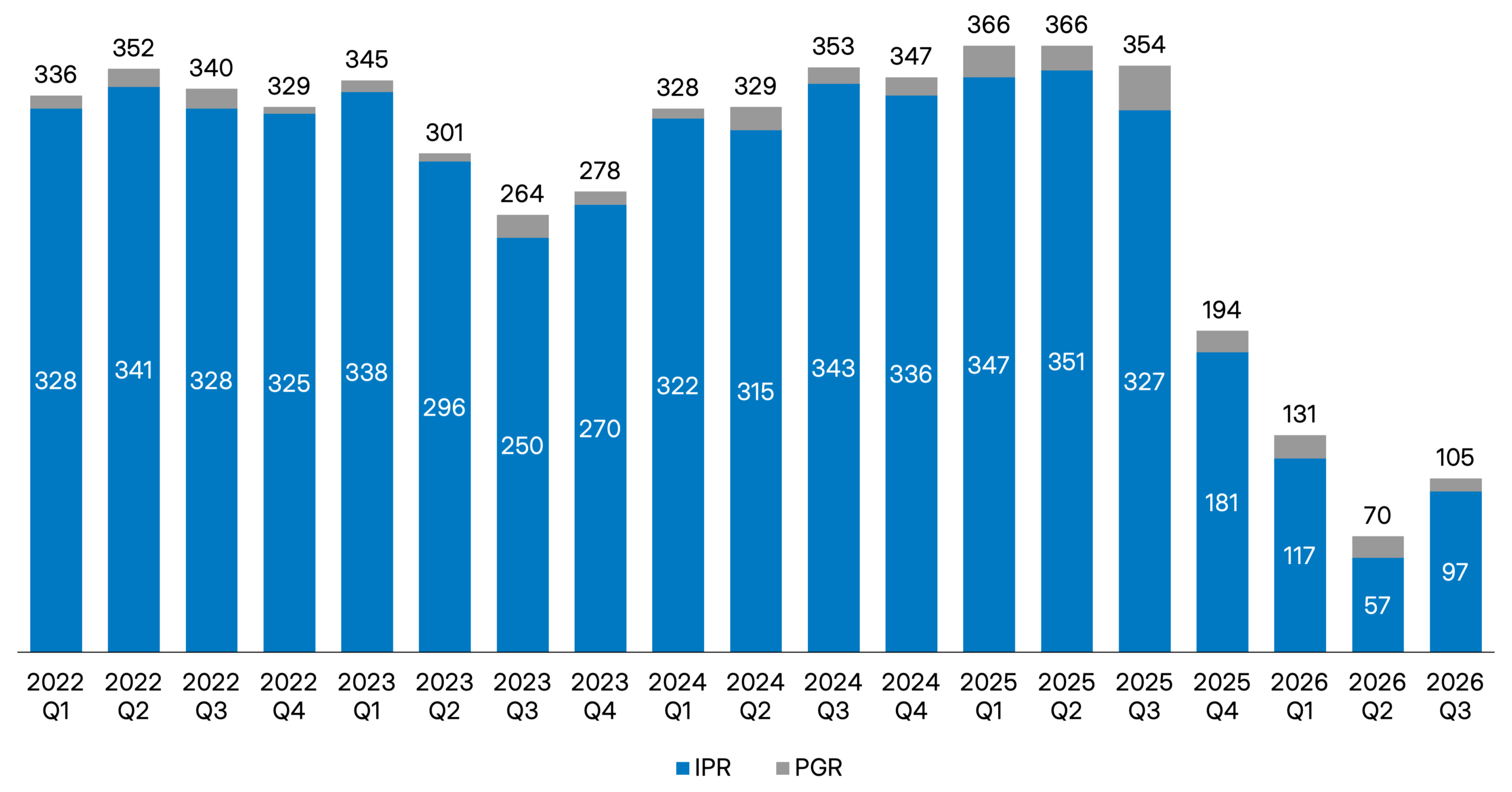
This overall downturn was precipitated by a series of changes at the USPTO over the past 18 months that have increasingly limited access to the PTAB—perhaps most notably, through new processes governing institution in AIA reviews.
In March 2025, then-Acting Director Coke Morgan Stewart created an interim process where she would decide requests for discretionary denial, while leaving the assessment of the merits to panels of PTAB administrative patent judges (APJs). Under that interim process, Stewart would make a discretionary denial determination by applying an expanded set of discretionary factors based on various PTAB precedents—including one factor where institution is less likely for older patents based on the “settled expectations” of the parties, and another where a petition may be denied based on a prior adjudication of validity for the challenged claims by the USPTO or another forum. The Acting Director would then refer the surviving petitions to a panel for consideration of the merits and other nondiscretionary institution factors. Despite the shift in discretionary decision-making back to the acting director, Stewart maintained the prior practice of issuing full written decisions explaining the reason for granting or denying discretionary denial.
Then, in October 2025, Director John Squires announced that he would now decide all aspects of AIA review institution himself, including discretionary considerations and the merits. That director-led institution procedure built upon the March 2025 interim process, superseding it to the extent that most petitions now only receive summary decisions that provide little, if any, insight into the director’s rationale for denying or granting institution; and to the extent that the nondiscretionary aspects of institution are no longer referred to panels.
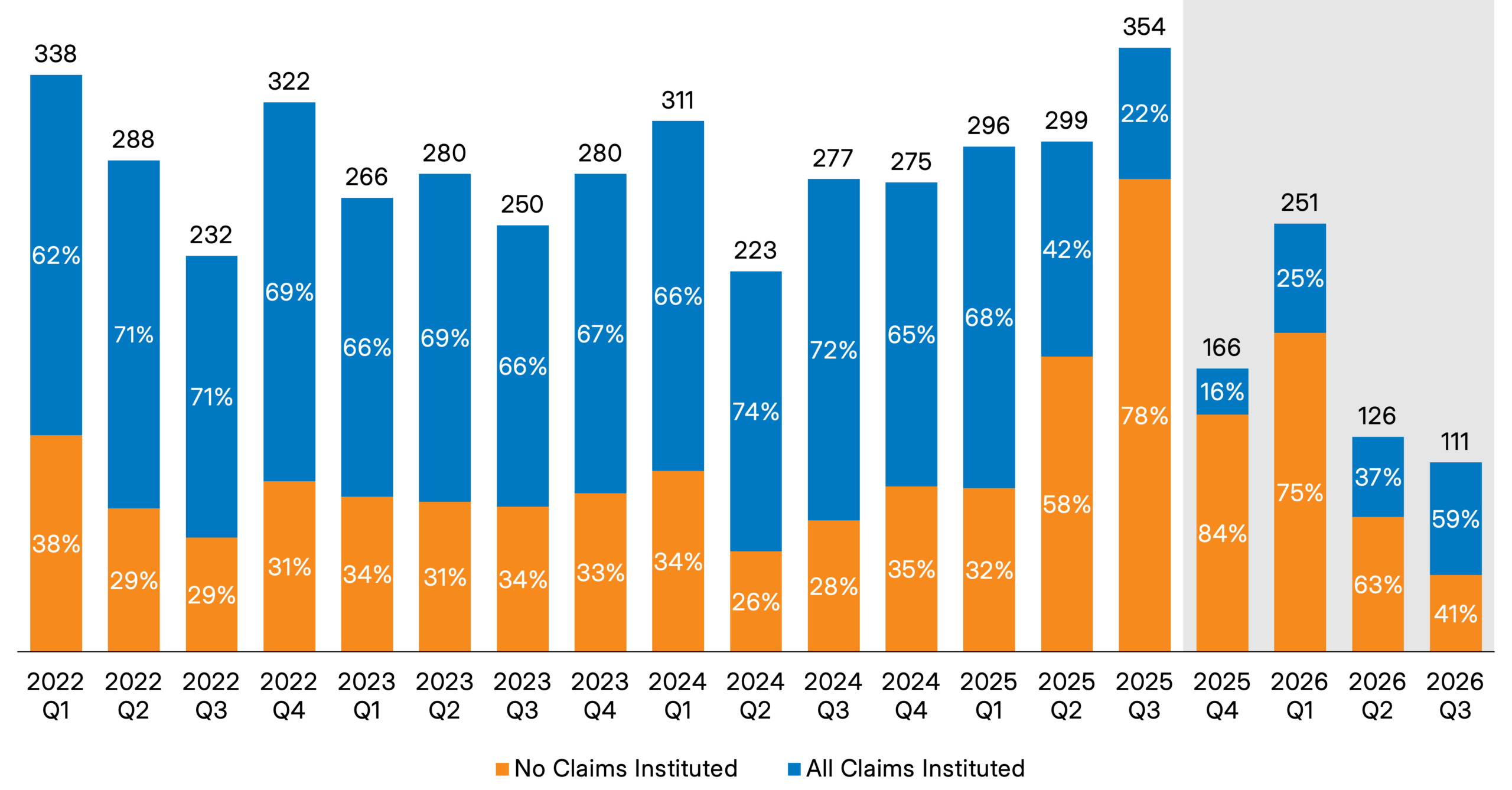
Institution rates fell dramatically over the course of 2025 as a result of these changes, dropping to a low of 16% in Q4 2025 for decisions decided by Squires (i.e., those not already referred to panels under the interim process). That said, the Squires-only institution rate has steadily climbed back up in subsequent quarters—reaching 59% in Q3 2026.
Squires Announces Plan to Return Merits Institution to PTAB
As Q3 drew to a close, Squires then announced that he intends to hand the merits prong back to the PTAB in October 2026, essentially restoring the earlier bifurcated process one year after taking over that portion of the analysis.
In written testimony submitted to the Senate IP Subcommittee for a September 29, 2026 USPTO oversight hearing, Squires characterized the centralization of first discretionary institution review and then merits institution in the Director’s office as a “reset” that “allowed the Office to articulate policy consistently, apply the governing thresholds with single accountability, and develop a more complete institutional record”.
Squires also detailed various actions that he characterized as serving those priorities—including the issuance of precedential decisions like Magnolia Technologies v. Kurin, which detailed the principles underpinning the Director’s current approach to discretionary denial; the Learning from Outcomes to Optimize Patents (LOOP) program, which takes information on apparent examination errors learned during AIA review and feeds it back into the examination process; the aforementioned rulemaking proposal, detailed further below; and decisions that more stringently enforce the requirement to disclose real parties in interest (RPIs) in PTAB proceedings.
Squires additionally touted the results of an internal program called “PTAB STRONG” (“Support, Training, Resources, Opportunities, Networking, and Guidance”) designed “to build institutional alignment among” APJs and the USPTO Director’s office: This program, per Squires, “combined internal learning with engagement from experienced academics and practitioners on institution standards and Board administration” in order “to ensure that the reset became institutional knowledge rather than a set of individual decisions”.
Notably, Squires revealed that due to “progress” made under this initiative, he would be handing the merits prong of the institution process back to PTAB panels: “Based on the progress of that work, I have announced my intention to return merits institution determinations to the PTAB in October, one year after they were centralized. Accountability and institutional development should reinforce one another”.
Proposed Rules Limiting PTAB Under OMB Review
Another topic of questioning at the September oversight hearing, addressed briefly in Squires’s written testimony, was the USPTO’s proposal to further reshape the PTAB: In an October 2025 Notice of Proposed Rulemaking (NPRM), the agency sought to place significant new limits on AIA reviews, barring institution unless petitioners stipulate not to raise invalidity challenges under Section 102 or 103 in parallel litigation, where the parallel forum would likely address validity on that basis before the PTAB issues its final written decision, or where the patent’s validity has already been upheld by another forum.
The USPTO received over 2,800 unique public comments on the proposal by the December deadline. Among the stakeholders that published comments were a variety of frequent petitioner-defendants, many of which were staunchly opposed to the NPRM and some of which offered suggested revisions. Commenting in support, either in full or in part, were some operating companies with significant patent licensing businesses as well as certain NPEs and entities otherwise engaged in patent monetization.
Notably, the USPTO also received a letter in support of its proposal from some of the cosponsors of an overlapping, bipartisan PTAB reform bill before Congress, the Promoting and Respecting Economically Vital American Innovation Leadership Act (PREVAIL Act)—including two IP Subcommittee members, Senators Chris Coons (D-DE) and Thom Tillis (R-NC).
Both Senator Coons and fellow subcommittee member Senator Mazie Hirono (D-HI), the latter also a PREVAIL cosponsor, asked Squires for a status update on the NPRM at the oversight hearing. Squires informed the committee that the USPTO “team”, including “PTAB judges”, had finished its review of public comments and that the NPRM was now being reviewed by the Office of Management and Budget (OMB). Within OMB, the Office of Information and Regulatory Affairs (OIRA) reviews both draft and final agency rulemaking proposals; during the latter stage, which occurs after the public comment period, OIRA reviews the impact of the NPRM and may suggest or recommend changes.
Senator Hirono also asked Squires whether there are any “major differences” between the NPRM as submitted to OMB and the PREVAIL Act. The Director responded that he “wouldn’t say major differences” and stated that based on his understanding of the bill, the “intention” of both “the PREVAIL Act . . . [and] of the rule is to limit repeat challenges, to have quiet title sooner”. Senator Coons asked Squires to let the Subcommittee know if there were anything that it “could do to liberate that from the clutches of OMB and actually get it moving forward”. He also invited the Director to “convey our urgent interest in any way appropriate”.
More on both the Squires-led institution process and the NPRM can be found at “PTAB Rule Revamp: Director Takes Over Institution; Proposal Restricts IPRs with Parallel 102/103 Challenges” (October 2025). An update on public comments for the NPRM is also available at “Stakeholders Spar over USPTO Proposal to Limit AIA Reviews” (December 2025).
Decisions Flagging Inconsistencies Between PTAB and Other Proceedings Lead to Appellate Complexity
The USPTO has meanwhile taken steps to limit PTAB proceedings where the petitioner has raised overlapping arguments in another forum.
In September 2025, then-Acting Director Stewart issued a memorandum that broadened the PTAB’s consideration of prior adjudications of validity when patent claims being challenged before the Board or “substantially similar patent claims” have already been adjudicated by the USPTO, in district court, or before the International Trade Commission (ITC). The memorandum requires a PTAB panel to provide an explanation when it issues an “initial or final decision” that reaches a different factual finding and/or legal conclusion from a prior finding or legal conclusion by the USPTO, district court, or ITC—mandating a “more detailed” explanation when the decision relies on the “same or substantially the same evidence and/or arguments” presented to the other forum.
Squires has since invoked that memorandum in a series of decisions ordering the PTAB to revisit prior invalidity rulings, potentially leading to the revival of patents that had accounted for millions of dollars in damages.
One of those invalidity rulings came in the long-running and tangled campaign waged by Express Mobile, Inc. (XMO). In November 2025, a Delaware jury returned a verdict in the plaintiff’s favor, awarding it $170M from defendant GoDaddy for the infringement of single claims from each of two “Web Design” patents, also declining to invalidate either claim. One of those patents had previously been twice invalidated by the PTAB in an IPR filed by a defendant in another XMO suit, Meta, first through a decision vacated by the Federal Circuit on claim construction grounds and a second, on remand, that reached the same conclusion. On May 1, 2026, Squires convened a Delegated Rehearing Panel (DRP) to address whether the PTAB had justified reaching a different conclusion on validity from the jury, deciding on June 25 that it had not.
The resulting appeal hit an unusual snag on September 17, when the USPTO filed a motion for leave to intervene, asking the Federal Circuit to remand back to the PTAB in order to further address “novel and complex issues about USPTO guidance intended to ensure consistent results between district courts and the Patent Trial and Appeal Board”. Those apparently “novel and complex issues” included whether it was proper to give binding effect to a verdict from a trial in which a petitioner (i.e., Meta) was not a party and did not participate, whether the DRP correctly rejected Meta’s arguments as to whether a different outcome was warranted in the IPR, and whether it was proper under the Administrative Procedure Act (APA) to vacate the FWD “based on issues exceeding the scope of the Federal Circuit’s remand, without affording Petitioners notice and an opportunity to respond”.
Reexams Drop After New Pre-Order Procedure Leads to More Denials
As the USPTO continues to impose new limits on the PTAB, would-be petitioners have instead placed greater reliance in the past several quarters on ex parte reexaminations (EPRs), which are not subject to discretionary denials to the same extent. However, Q3 saw a notable drop due to recent changes at the USPTO, breaking that trend.
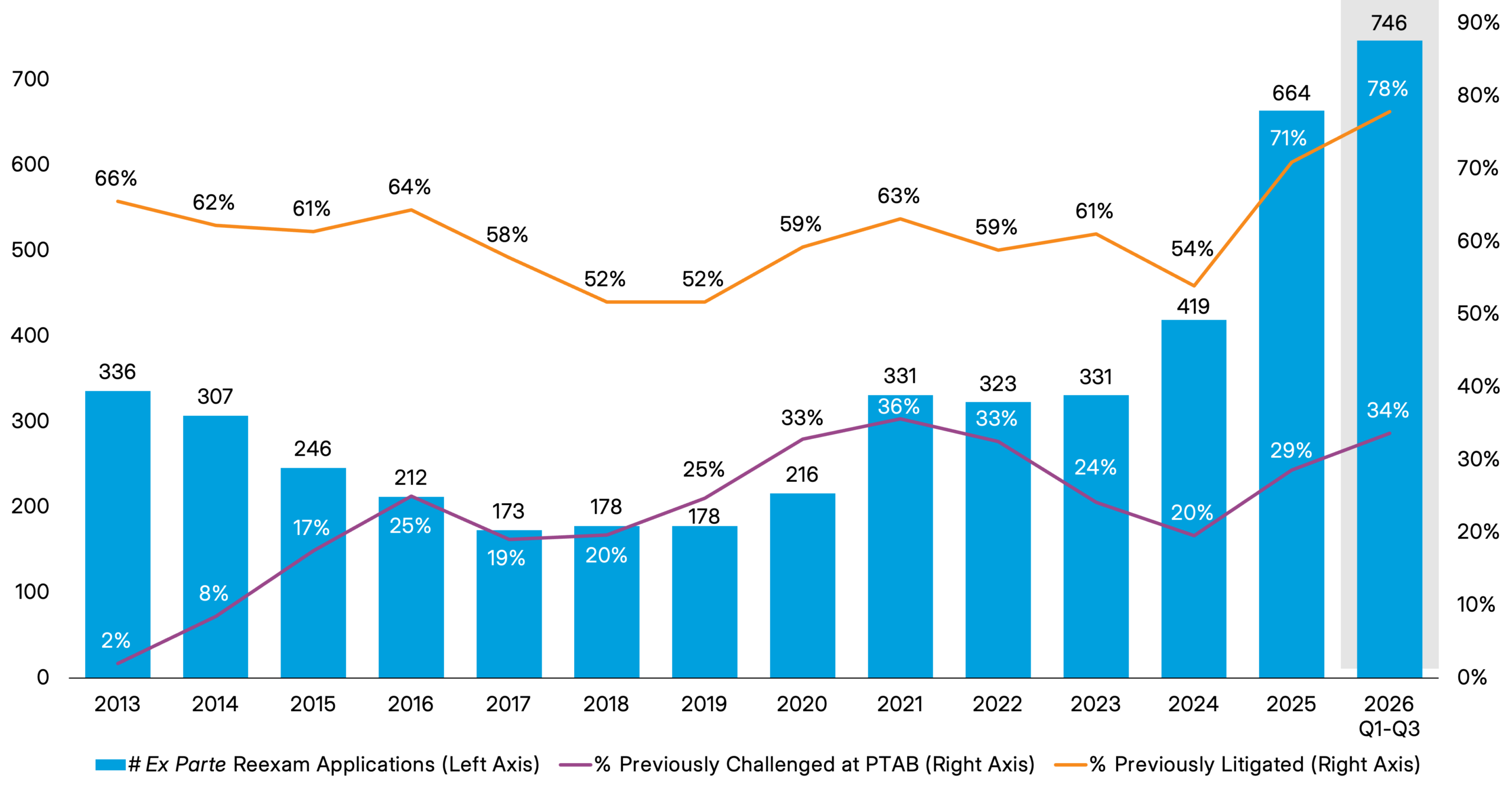
As RPX has previously noted, reexam filings have tended to climb in response to policy shifts that constrain IPR access: In 2020, the year that the Fintiv decision was designated as precedential, the number of requests for EPR increased by 21%, and then by 53% in 2021. While they held steady at about 330 requests per year in 2022 (the year Vidal issued a since-rescinded guidance limiting NHK-Fintiv) and 2023, they surged by 27% in 2024 (following a decision by Vidal, in CommScope v. Dali Wireless, that limited the “compelling merits” exception then in effect under the 2022 guidance) and jumped further, by 58%, in 2025.
Quarterly filing levels remained higher earlier in 2026: After 254 such requests were filed in Q1 2026, a 189% jump compared to that same quarter last year, Q2 saw 316 new filings, or 161% more than the year-ago quarter.
Yet the second quarter also saw the USPTO implement a new pre-order procedure for EPRs that gives patent owners the chance to file a paper arguing why the prior art raised in the EPR request would not establish a “substantial new question” (SNQ) of patentability, the threshold required to initiate an EPR. Prior to this change, patent owners would only get the chance to raise an SNQ argument after the USPTO decided to move forward with the EPR. The USPTO stated in announcing this change that it is designed to help the USPTO deal with the “recent increased volume of ex parte reexamination requests”. Practitioners have interpreted the new process as giving patent owners an early procedural advantage (see, e.g., here, here, and here) and even as “rebalancing” EPRs in their favor (see here).
Early data indicate that the USPTO denied significantly more EPRs in Q2, the first quarter during which the pre-order procedure was in effect: The most recent operational statistics released by the agency show that it cumulatively denied ten EPRs through the first fiscal quarter (October-December 2025, or Q4 2025 using calendar-year quarters); 13 through the second fiscal quarter (January-March 2026, or Q1 2026), or a slight uptick of three denials; and 54 in the third fiscal quarter (April-June 2026, or Q2), or an increase of 41 denials. Given that the USPTO must decide whether to grant or deny EPR requests within three months under 35 U.S.C. § 302(a), and that the agency reports an average time to grant or deny of 1.96 and 2.06 months for the third fiscal quarter of 2026, it is likely that many, or even a majority, of the 41 denied EPR requests were filed during the second fiscal quarter, or Q1 for the calendar year.
It appears that the new pre-order procedure and resulting denials have since had a chilling effect on EPR requests in Q3 2026: Just 176 such requests were filed in the third quarter, or 44% fewer than in Q2 2026, and the same amount as in Q3 2025. That said, given how far ahead filings were in Q1-Q2 compared to those same quarters the year prior, 2026 has to date already eclipsed 2025 in its entirety: 746 requests have been filed through Q3 2026, compared to 664 in all of 2025 (marking an increase of over 12%).
The USPTO has also proposed a change that could partially undercut another advantage of EPRs: Unlike IPRs, an EPR can currently be filed anonymously through a practitioner, who must certify that the neither the requester nor any real party in interest (RPI) or privy would be barred from filing the EPR request due to IPR estoppel (which would here bar the petitioner from a prior IPR, its RPI, or privy from requesting EPR for a claim based on grounds they raised or reasonably could have raised in that IPR). However, on July 22, 2026, the USPTO filed an NPRM that would require third parties requesting an EPR to file a statement identifying all RPIs to the request, with that statement to be kept confidential on request. The USPTO framed the change as needed to ensure that the agency can properly verify compliance with statutory estoppel requirements, framing the current system allowing anonymity as being in “tension” with those rules.
Stakeholders that submitted comments by the August 21 deadline included a range of patent owners, licensors, and related organizations that generally support the proposed rule: Some of those commenters argued that patent owners should not be subjected to challenges without knowing whether the requester is a licensee, competitor, an entity affiliated with an estopped party, or an organization with foreign backing; with some stating that the NPRM strikes the right balance and others contending that it should further require information on the requester’s business model and funding sources, for example.
Opponents of the proposal included various industry organizations and others representing the IP industry more broadly, which variously argued that the USPTO had not provided sufficient evidence of failures related to the current certification system, cautioned against importing a fact-intensive RPI requirement that they warned could unduly disrupt what is now a streamlined process, and asserted that the new rule would undercut a valuable strategic advantage by barring parties from filing challenges without exposing themselves to retaliatory litigation. Some also argued for stronger confidentiality protections, broadly echoing earlier commentary in which some practitioners warned that Freedom of Information Act (FOIA) requests and data breaches could undercut the USPTO’s assurances that requester identities would be kept private on request.
UPC Update: Filings Hold Steady and German-Heavy, Spanning Range of Plaintiffs and Products
The volume of patent infringement litigation at the EU’s Unified Patent Court (UPC) has held steady so far in 2026. The UPC has reported that 174 such cases were filed in Q1-Q3, or exactly the same number as in that same period in 2025 (based on data retroactively reported in the court’s 2025 annual report, following a temporary pause in filing data publications last year as the court transitioned to its new Case Management System (CMS)). In the third quarter, plaintiffs filed 72 new infringement suits, up from 63 in Q3 2025.
The German local divisions have continued to see the bulk of new filings, accounting for 72% of the infringement suits filed so far this year and 76% of those in Q3. While the Munich Local Division (Munich LD) has continued to see the most cases of the German local divisions, the Düsseldorf Local Division (Düsseldorf LD) has seen an increase as well, even pulling ahead of Munich for the first time for cumulative first-instance filings in August (counting all types of cases, not just infringement).
The heavy concentration of filings in the German local divisions has been the subject of some criticism within the patent community in Europe: As RPX reported in its Q2 in Review, a survey of patent law practitioners earlier this year reflected a near-even split between practitioners based in Germany, who favored existing case distribution practices; and those based elsewhere in Europe, who tended to favor changes to the current approach, including various short-term, non-legislative measures and more sweeping rule changes that would require amendments to the UPC Agreement.
In early July, the UPC’s Administrative Committee, comprised of representatives of the UPC member states, met to address such criticisms following a “wide-ranging consultation on the issue”, JUVE Patent has reported. The Committee reportedly decided against taking steps to proactively allocate new claims across all divisions, a change that would need an amendment to the UPC Agreement, which certain “insiders” tell JUVE Patent is unlikely to gain the support of a majority of member states.
According to a position paper from the UPC Presidium reviewed by JUVE, the UPC does not want to undermine plaintiffs’ choice of forum and wants to work within the existing UPC Agreement, though it has taken steps within that framework to promote a more even case distribution. Reportedly among them is a change wherein “experienced judges — including those from busy divisions — should be seconded more frequently to divisions with few cases”, thereby making those smaller divisions more attractive. With respect to UPC judge panels, which in larger divisions include two national judges and one international judge, the role of the international judges will be “strengthened” by more regularly making them the judge-rapporteur, a key case management role. Various procedures will also be harmonized among local divisions, including by making preliminary opinions (as practiced to certain degrees in the divisions in France, Germany, and the Netherlands) the rule.
UPC Litigation Activity in Q3
The third quarter also saw a variety of new UPC lawsuits filed by various entities focused primarily on patent monetization, including litigants based in Europe, the US, and South Korea.
Among them is German NPE Papst Licensing GmbH & Company Kg, which has continued to file UPC litigation (as well as claims in the Munich Regional Court) against robot vacuum manufacturers: On September 1, the plaintiff sued Roborock in the Hague Local Division, shortly after the Munich Local Division (Munich LD) dismissed its June 2025 case against the same defendant over a different patent after finding no infringement under a more limited claim construction than the one advanced by Papst. The plaintiff’s June 2025 case against fellow robovac maker Ecovacs has moved forward, while the two defendants have also traded litigation between them: Ecovacs sued Roborock in the Munich LD in February 2026, while Roborock responded with a Munich LD suit of its own in August.
Another German plaintiff filing new UPC litigation has been Partec AG: In early July, Partec and BF Exaqc AG, Partec’s exclusive licensee and licensing agent, filed a case against HP Enterprise in the Munich LD over two high-performance computing patents variously at issue in a host of other UPC suits filed from 2024 onward.
A notable pair of UPC cases also came from Malikie Innovations Limited, an entity linked to Irish patent investment firm Key Patent Innovations Limited: On July 9, the company sued a group of defendants including OPPO, OnePlus, and Realme in the Mannheim Local Division (Mannheim LD) as well as before Germany’s Munich Regional Court and India’s Delhi High Court, asserting 4G and 5G SEPs. Then, on August 7, Malikie sued Abbott Laboratories in the Hamburg Local Division, weeks after it sued the company in the Eastern District of Texas over the provision of neurostimulation devices and related mobile apps with certain Bluetooth functionality.
Moreover, on August 26, Skysong Innovations, LLC, the “exclusive intellectual property management and technology transfer organization for Arizona State University” (ASU), filed a pair of cases over cybersecurity exploitability scoring in the Hague Local Division: One against Crowdstrike and the other against Fortinet; the nonprofit Forum of Incident Response and Security Teams (FIRST), which runs a certain security model; and Empirical Security, which builds and maintains that model. The suits follow a pair of cases that Skysong filed against Crowdstrike and Fortinet (the latter here sued alone) in the Western and Eastern Districts of Texas, respectively, in January 2025.
Q3 also saw plentiful new standard-essential patent (SEP) litigation. For instance, on July 30, the Electronics and Telecommunications Research Institute (ETRI), a South Korean government-funded research institution and a licensor in Access Advance LLC’s Video Distribution Pool (VDP), sued Snap in the Mannheim LD over a single video coding patent as part of a wave of litigation that also included suits in the US and Brazil. The filings prompted Snap to file a FRAND declaration suit in the UK, an increasingly common defensive strategy.
Additionally, on August 10, Dolby—a member of the Voice Codec pool administered by Via Licensing Alliance LLC—sued two subsidiaries of Nothing Technology as well as GameGeek, the contracting seller for Nothing’s EU online store, in the Munich LD over a declared SEP covering the EVS (Enhanced Voice Services) standard.
Finally, on July 14 and August 24, subsidiaries of InterDigital, Inc. filed three additional UPC suits against Disney (the July action in the Mannheim LD and the two August suits in the Mannheim LD and the Düsseldorf LD) as part of an ongoing multijurisdictional campaign over video streaming. The Mannheim August suit, in particular, relates to the use of the VP9 codec in the Disney+ platform, implemented as a workaround for a prior injunction based on the use of the HEVC codec; while the Düsseldorf August suit targets “Up Next” autoplay functionality.
FRAND Update: Top SEP Venues Hold That Pool License Offers Can Satisfy FRAND Obligation
In Q3 2026, among the most significant developments related to standard essential patent (SEP) litigation were three appellate decisions dealing with licensing through patent pools: Within two weeks of one another, the UK Supreme Court and Brazil’s Rio de Janeiro Court of Appeals both held that a patent owner can satisfy its obligation to offer a license on fair, reasonable, and nondiscriminatory (FRAND) terms by offering it a license to a pool including the patent owner’s SEPs. In the ensuing weeks, the EU’s Unified Patent Court (UPC) also issued multiple decisions addressing pool-related FRAND claims, one of which also determined that a pool license can satisfy the patent owner’s FRAND obligation.
UK: Tesla v. Avanci and InterDigital
The UK Supreme Court’s landmark July 27 decision involved an unprecedented type of case brought by automaker Tesla seeking a FRAND declaration against an entire patent pool—specifically, for the Avanci 5G licensing platform administered by defendant Avanci, LLC, with codefendant InterDigital, Inc., an Avanci 5G member, named as the “representative” of the other SEP owners participating in that pool.
In March 2025, a divided UK Court of Appeal affirmed the High Court’s prior dismissal of the case: Lord Justices Stephen Phillips and Philippa Whipple authored brief opinions in favor of dismissal, both holding that Tesla had not shown that the patent licensing policy of the relevant standard-setting organization obliges members to offer their patents for licensing on a “collective” basis. As a result, they concluded that Tesla had not shown the requisite legal right to its claim for relief, rendering it the same type of “free-standing” FRAND claim barred under prior caselaw (in particular, the Court of Appeal’s 2021 decision in Vestel v. Access Advance). Lord Justice Richard Arnold, who had recently authored the court’s interim license decision in Ericsson v. Lenovo, issued a much lengthier dissent explaining why he would have allowed Tesla’s claims.
The Supreme Court reversed that judgment, ruling that a patent owner’s FRAND obligation does not cease to apply when it offers its patents through a patent pool. As a result, the Supreme Court determined that the automaker has a viable claim that the only FRAND license for the InterDigital SEPs in suit is a global license to the Avanci 5G platform. The decision notably expressed the view that as a matter of “commercial reality”, it is generally impractical for an implementer to negotiate bilateral licenses with all licensors holding relevant patents—and that for a “large proportion of SEPs”, a pool or platform license is the only one available.
Brazil: Panasonic v. HMD
Meanwhile, the decision in Brazil came in litigation over Advanced Audio Codec (AAC) technology filed by patent owner Panasonic against HMD. The decision upheld an April 2026 judgment by the 6th Business Court of the Capital District of the State of Rio de Janeiro. In that earlier ruling, the trial court granted a preliminary injunction against HMD, reportedly stopping short of deeming the defendant an unwilling licensee but finding its conduct indicated that it lacked the intent to take a license. Most relevantly, the court rejected HMD’s FRAND defense, in which the defendant had argued that Panasonic had violated its FRAND commitment by offering only a license to the AAC pool administered by Via Licensing Alliance LLC, and allegedly refusing to negotiate a bilateral license: Rather, the court held that a patent owner meets its FRAND commitment when offering a SEP license via a pool, pointing to examples in which Brazilian law recognizes “commercial arrangements involving exclusive collective intermediaries” (as paraphrased by IAM), including the country’s statutory copyright collection system.
The Court of Appeals affirmed the preliminary injunction on appeal on July 16, 2026, agreeing with the trial court’s findings with respect to the defendant’s conduct. While the bilateral license demand was not formally part of the appeal, the appellate court nonetheless briefly addressed the issue: It found that centralized licensing through patent pools “substantially simplifies” the licensing process and that the Via pool offer in this case satisfies the requirements of equal treatment and nondiscrimination, “since it provides identical rates and conditions to hundreds of companies in the sector, including direct competitors of the appellants in the national market” (quoted here and below from a machine translation from the original Portuguese). As a result, the appellate court held that the position that an implementer is entitled to a bilateral offer is without “logical, legal, and economic support” and that the Brazilian legal system is compatible with, and even favors, exclusive “collective rights management systems”.
UPC: Fraunhofer v. HMD; Dolby (and Vectis) v. Acer
The third quarter also saw the UPC issue two notable rulings in FRAND cases involving patent pools, the first of which came in another AAC case against HMD by another Via pool licensor, Fraunhofer, here filed in the Hague Local Division (Hague LD). The underlying dispute here began in 2017, when Via first contacted HMD to demand it take a pool license, but the defendant instead “insisted on the option of a bilateral license” with Fraunhofer. The parties began exchanging bilateral license offers later that year but did not come to an agreement. As would later become relevant, HMD did not provide a security during negotiations.
Ruling on August 25, the Hague LD found in the plaintiff’s favor on infringement, validity, and lack of exhaustion and then rejected the defendant’s FRAND defense. For that last issue, the court ruled that “[u]nder European Competition Law the patent holder can, in principle, fulfil its obligations by either offering a pool license or a bilateral license”, as competition law only requires the patent owner “to indicate to the patent user one licensing route that satisfies the FRAND requirements”. However, the court also held that there are certain circumstances where an implementer can insist on a bilateral license, including when the implementer wants to enter into a “multi-standard-licence or to sign cross-licencing agreements with the individual patent proprietors”, or where the implementer had already entered into bilateral license agreements “with a significant number of other pool contributors”—as long as the implementer has “comprehensible reasons” for wanting a bilateral license.
The court found that HMD had not shown such “comprehensible reasons” here, underscoring that the defendant “never came into possession of sufficient bilateral agreements with the other SEP pool licensors, and even then, refrained from placing a security for Claimant’s potential licence claims”. As a result, the court concluded that the defendant had been “unwilling to sign a licence” with Fraunhofer, thus rejecting the FRAND defense and proceeding to grant a five-country injunction.
The other pool-related decision came from the Court of Appeal, in what appears to be the UPC’s first-ever case involving a claim or counterclaim against a pool administrator. Here, the suit in question involved the latter scenario, in a Hague LD case that Dolby filed in November 2025 against Acer over a patent declared essential to the Opus audio standard and licensed through the Opus patent pool run by Vectis IP Ltd. In February 2026, Vectis asked to intervene in the case in support of Dolby, which then moved to add Vectis as a party under Rule of Procedure (RoP) 305.1 rather than as an intervener under RoP 315.1. Dolby and Vectis, arguing in favor of the latter avenue for adding Vectis, had asserted that the rate-setting counterclaim filed by Acer could not be directed at the pool administrator.
In May 2026, the Hague LD found Acer’s counterclaim to be admissible against Vectis without resolving the party vs. intervenor dispute because, under RoP 315.1, an intervenor “is to be treated as a party, unless otherwise ordered by the Court”. On that point, the court rejected arguments from Dolby and Vectis that because Vectis was not the patent owner or a licensee, it lacked standing to serve as a party, that court countering that this affected the ability to file the case, not join one. The court also rejected their arguments that Vectis’s lack of patent ownership meant that it did not have a dominant position as related to substance, not admissibility, and that they must be addressed later at the oral hearing.
In July, the lower court declined to overturn that decision, confirming that since an intervenor is to be treated as a party, a rate-setting counterclaim is properly directed at one—particularly so under the principle of “equal treatment” since Vectis intervened on the side of the plaintiff. Among other findings, the court observed that it would “incomprehensible” if Vectis could defend Dolby in this case, but Acer were then required to bring a standalone rate-setting claim against Vectis. The court also agreed with Acer that it makes sense to add Vectis as a party, holding that if the Court of Appeal were to disagree about the counterclaim’s admissibility against Vectis as an intervenor, it would then add Vectis as a party. To that end, the court granted permission to appeal.
On August 5, the Court of Appeal denied a motion by Dolby and Vectis to stay the litigation below at least with respect to the rate-setting counterclaim against Vectis pending their appeal, which in part challenged the court’s jurisdiction to hear the counterclaim. The appellate court held that such a stay is only justified in extraordinary circumstances and found none here, observing that regardless of the outcome of the appeal on this issue, “the Court of First Instance will inevitably deal with Acer’s FRAND defence, including the negotiation record between Acer and Vectis and the offers made on both sides”. The Court of Appeal also found that the lower court’s ruling was not “manifestly erroneous”, and that it would decide the merits of the challenged parts of that ruling on appeal.
If this appeal fails, the Hague LD would have to decide whether it can, or should, set a global rate for the Opus patent portfolio—which, as IAM has also observed, is a similar conundrum to the one now faced by the UK High Court following the UK Supreme Court’s decision in Tesla v. Avanci and InterDigital, as discussed above. Such a ruling by the Hague LD would also mark the first time that the UPC decides a FRAND rate-setting counterclaim on the merits: In Panasonic v. Oppo, the parties settled before the Mannheim LD could rule on the FRAND rate, though the court nonetheless still issued a decision in which it found implementer Oppo’s FRAND counterclaim admissible but unfounded. In Huawei v. NETGEAR, the Munich Local Division (Munich LD) held that implementer NETGEAR could not rely on a FRAND defense under the circumstances.
Patent Market Update: Courts, Legislatures, and Litigants Keep TPLF in the Spotlight; Noteworthy Patent Transactions Revealed in Q3
TPLF Disclosure Debate Continues to Gain Momentum
Policy attention to third-party litigation funding (TPLF) continued to build during Q3, particularly among state legislatures. In early July, New Hampshire Governor Kelly Ayotte signed HB 1384, the state’s Third-Party Litigation Funding Transparency Act, which restricts litigation financing by foreign adversaries and certain foreign-affiliated entities.
The measure followed a series of recent state-level actions addressing TPLF. Also in July, Ohio enacted HB 105, imposing registration requirements on litigation funders, limiting their ability to influence litigation and settlement decisions, and addressing concerns over foreign-backed funding. In June, North Carolina became the first state to broadly prohibit TPLF when Governor Josh Stein signed HB 315, the Prohibit Litigation Investments Act, into law.
While state laws do not directly govern federal patent litigation, they establish a body of legislative and practical experience from which federal policymakers can draw. As more jurisdictions adopt disclosure regimes and other restrictions, arguments that such requirements are unworkable or incompatible with access-to-justice concerns may become increasingly difficult to sustain.
The issue has also reached Congress, where lawmakers have introduced several bills aimed at regulating TPLF. However, whereas TPLF disclosure has attracted bipartisan support in the states, in Washington, the debate is markedly more partisan, with disclosure initiatives primarily driven by Republican lawmakers.
Meanwhile, the judiciary has moved to the forefront of the disclosure debate. A growing number of federal judges have adopted standing orders requiring disclosure of litigation funding arrangements, and judicial rulemakers are now considering whether such requirements should be standardized nationwide.
That effort may reach an important milestone later this month. On October 21, the Judicial Conference’s Advisory Committee on Civil Rules is expected to consider next steps toward a proposed amendment to the Federal Rules of Civil Procedure that would require disclosure of TPLF arrangements in federal civil litigation. Ahead of that meeting, more than 200 companies representing a broad cross-section of the US economy renewed a call for a uniform federal disclosure rule, arguing that the current patchwork of court-specific requirements creates uncertainty, encourages forum shopping, and undermines transparency in federal litigation.
Whether the Advisory Committee ultimately recommends a disclosure rule remains uncertain. However, even if the Advisory Committee were to formally endorse a TPLF disclosure proposal in the near future, a final rule would likely remain several years away. Public comment periods, committee review, revisions, and multiple levels of approval would precede implementation. Still, the Advisory Committee’s October meeting may give the clearest signal yet regarding whether TPLF disclosure is poised to become the Judiciary’s next significant civil-rulemaking project.
Funded Patent Litigation Remains a Significant Force
TPLF remained an important feature of the patent landscape during Q3, with RPX continuing to identify funded patent plaintiffs and monitor developments involving major litigation finance firms and also institutional investors. Among the quarter’s most notable developments was the Southern District of California jury’s $5.7B verdict in favor of Taction Technology against Apple. As discussed in the “Venue Update” section above, the case attracted particular attention because of Taction’s relationship with litigation finance firm Burford Capital, which had previously become the subject of discovery disputes concerning the plaintiff’s funding arrangements. Shortly after the Taction trial, Burford disclosed that, if the award were ultimately upheld and paid in full, its share of the recovery would be approximately $1.4B, divided roughly equally between its balance sheet and managed funds. (Burford also noted that the award remains subject to motions, appeals, settlement negotiations, and collection risks, such that any ultimate recovery could be materially lower.)
Viewed alongside major financial institutions and alternative asset managers, Burford remains a comparatively small public company. At its 2025 Investor Day, the company reported a market capitalization of approximately $3B, alongside a $7.4B legal finance portfolio that it described as the largest in its industry. However, since then, the market has markedly repriced the company. Following developments related to the YPF litigation, Burford’s market cap has fallen below $1B, despite the company continuing to manage a multibillion-dollar portfolio of legal assets and investments. As of the publication date of this post, Burford’s market capitalization stood at approximately $800M, having decreased by roughly 69% in one year. Burford’s share price has also declined, falling from approximately $12 per share in October 2025 to roughly $3.65 by October 2, 2026 (on which date RPX published a deeper dive into Burford’s outsized impact on the patent space).
The quarter also highlighted the divergent outcomes that can emerge from funded litigation. While Taction secured one of the largest patent verdicts in recent memory, an Eastern District of Texas jury returned a comprehensive defense verdict in litigation managed by Celerity IP, a subsidiary of GLS Capital. Founded by former Burford Capital employees, GLS Capital has raised hundreds of millions of dollars from institutional investors and has funded multiple patent campaigns. The Celerity verdict serves as a reminder that litigation finance, whether deployed by Burford, GLS Capital, or other funders, remains subject to the risks inherent in patent litigation.
Taken together, these developments help explain why litigation finance has continued to attract attention from courts, lawmakers, and litigants. Burford Capital is a relatively small public company, judged by traditional market metrics, but nonetheless maintains financial exposure to disputes involving some of the world’s largest technology companies—and potential recoveries measured in the billions of dollars. As litigation finance continues to play a larger role in patent litigation activity, questions concerning transparency and disclosure are likely to remain at the forefront of the policy debate.
RPX continues to expand its visibility into the litigation finance space through systematic review of court, corporate, and regulatory filings. RPX subject matter experts have identified hundreds of relationships between patent holders, law firms, and specific litigation funders, providing its members with greater insight into the role of third-party capital in patent assertion activity. RPX members can now also request tailored presentations on TPLF; please contact your RPX representative for more details.
Patent Transactions of Note
Although concerns persist regarding the completeness of public USPTO assignment data, RPX closely tracks patent transfers for indications of new or expanding monetization and litigation activity. Notable assignments made public in Q3 involved Crestone IP Management, LLC (see here); Dominion Harbor Enterprises, LLC (here); Eight Deer Ventures LLC (here); and Sauvegarder Investment Management, Inc. (d/b/a SIM IP) (here).
Additional RPX Patent Market Intelligence
Visit RPX Empower for further analysis and up-to-date information on patent litigation and market trends.