E-Seller Litigation Remained Lower in Q2 as Courts Scrutinized “Schedule A” Practices
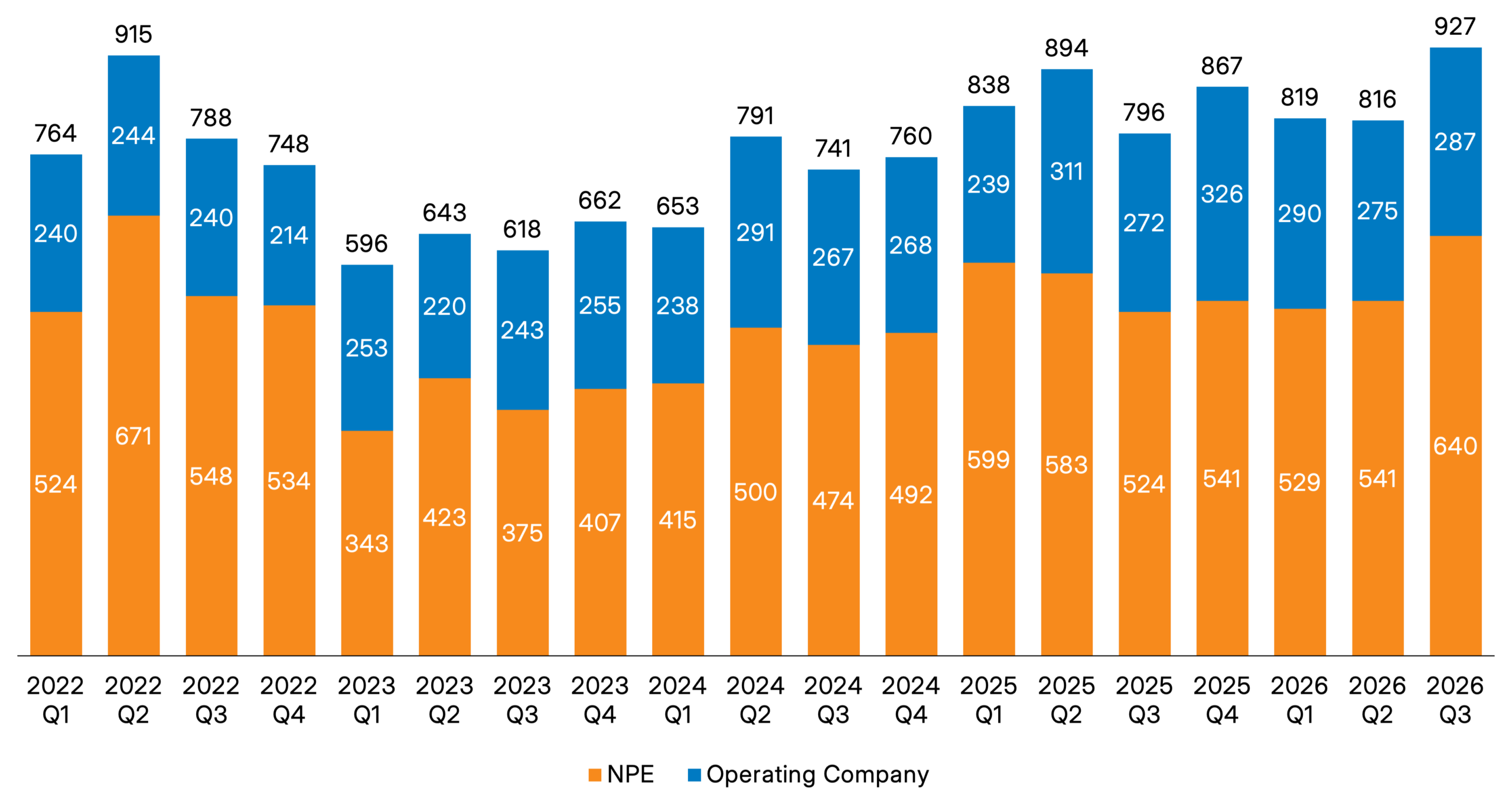
RPX’s latest quarterly report shows that litigation from operating company plaintiffs decreased by 8% in Q2 2026 compared to the second quarter last year. Operating company filings last quarter were also 2% lower than in Q1 but beat the trailing Q2 2023-2025 average by 5%.
However, the above data leave out another distinct category of litigation filed by a small group of design and utility patent owners targeting copycats and counterfeiters selling products online. RPX excludes such “e-seller” cases from analyses of district court litigation because they tend to follow a different dynamic compared to what one might consider the usual patent suit. These e-seller cases sometimes name hundreds of defendant entities, many of which may be merely online storefronts or aliases for the same ultimate parent. Also, plaintiffs primarily seek injunctive relief instead of damages, and their cases often end with the e-seller defendant’s failure to answer, followed by a default judgment.
This category of litigation is shown in grey below to illustrate its magnitude. As shown by the rightmost bar, e-seller litigation in Q2 2026 accounted for 851 defendants added, or 50% of all litigation during the quarter. As was also the case for the past three quarters, this represents a much lower volume of e-seller litigation than in recent quarters past.
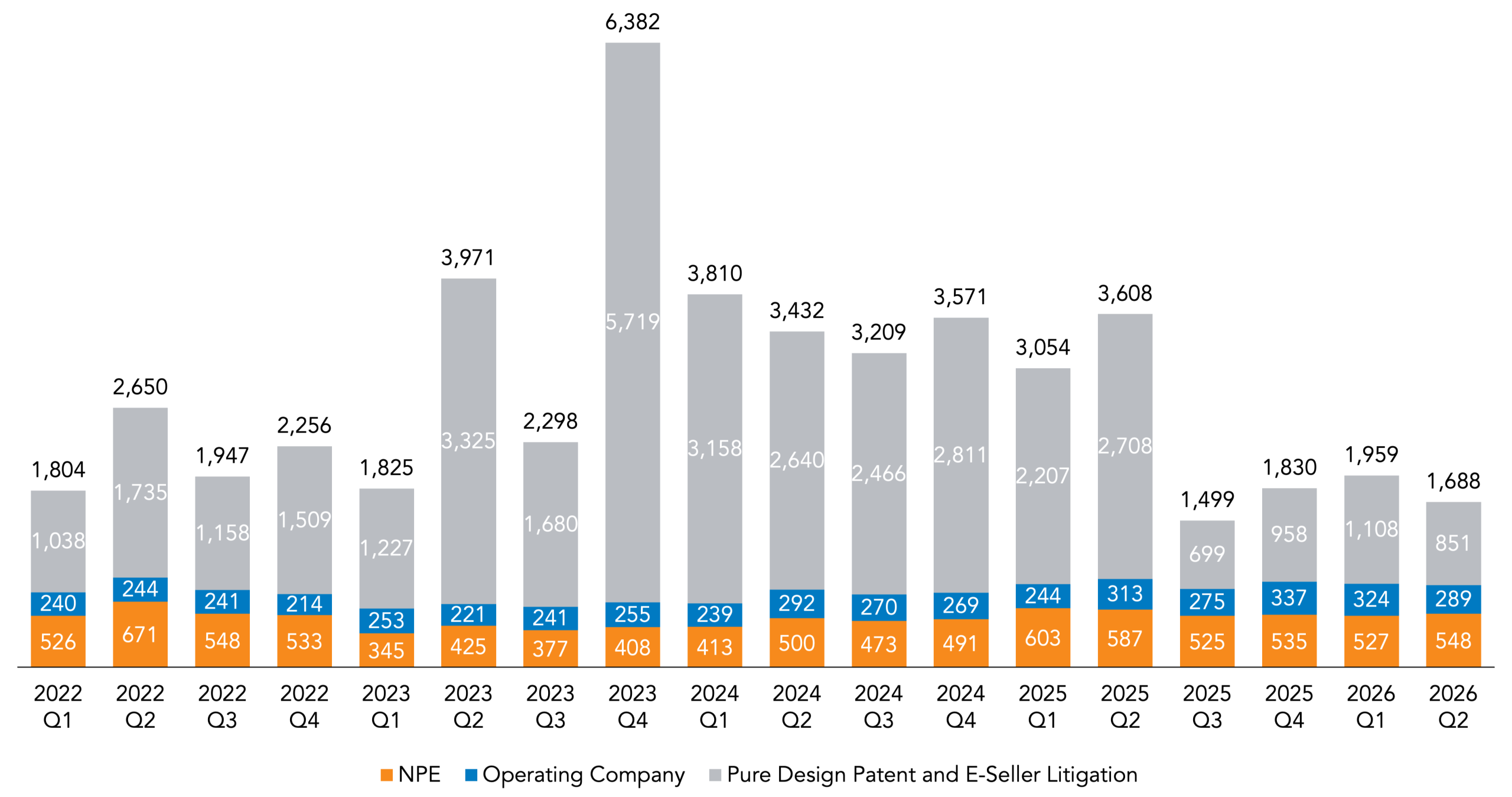
While the lower counts for the past four quarters are still subject to the caveat about defendants potentially having multiple online storefronts, as noted above, the decrease could also be related to efforts by some judges to apply stricter procedural rules to e-seller cases: As recounted in RPX’s Q1 in Review, these efforts include decisions and orders from judges in the Northern District of Illinois (urging plaintiffs to seek the relief described above through other means), the District of New Jersey (requiring more specific and plausible allegations of personal jurisdiction), and even the Eastern District of Texas (barring plaintiffs from seeking ex parte temporary restraining orders to freeze the assets of accused infringers for e-seller cases over utility patents).
Another recently scrutinized aspect of e-seller cases—also widely known as “Schedule A” actions, after the sealed exhibits used to identify defendant storefronts—involves service of process. Defendants located in other countries must typically be served through a central authority located in that country under the Hague Service Convention, a process that can be particularly slow when defendants are based in China. Schedule A plaintiffs have argued that provisions from the Convention allowing service by “postal channels” also allow service via email, which has become the dominant means for service in such actions. However, in the past year, two regional circuits—the Second and Seventh Circuits, the latter of which governs what is by far the top forum for Schedule A cases, the Northern District of Illinois—ruled that the Hague Service Convention bars service by email for defendants in China. An impacted Chinese e-seller that was hit with a default judgment after being served by email recently invoked one of those decisions in an unusual class action suit that seeks to overturn numerous default judgments against Chinese defendants served by email in all Schedule A cases filed in the Northern District of Illinois.
On the other hand, the Federal Circuit also recently issued a decision in which it declined to address criticisms of Schedule A litigation, as part of a broader appeal over design patent standards. The case at issue, Jacki Easlick v. CJ Emerald (24-1538), challenged the Federal Circuit’s Egyptian Goddess decision, which asks whether an “ordinary observer” familiar with the prior art would find an allegedly infringing design to be “substantially the same” as the patented design—here as applied in a preliminary injunction denial in an e-seller case.
In February 2025, a group of intellectual property scholars filed an amicus brief (see corrected version here) that both argued the injunction denial should be affirmed and also highlights the “legal and procedural deficiencies” in both this case and Schedule A litigation generally. The amici highlighted what they characterize as the “abusive and legally flawed nature of Schedule A litigation, particularly in patent cases”: Such lawsuits “require judges to analyze extensive but vague allegations of infringement on an ex parte basis, and to do so quickly and at scale”, which the amici argued can be “especially harmful” when the result is to shut down storefronts and freeze “often-unrelated assets”.
The amici further contended that such cases are “rarely appealed” since the Schedule A model puts defendants at such an “extreme disadvantage”. As a result, they underscored that this case thus presents a “rare opportunity for this Court, in the course of evaluating the litigation and decision below, to address the abuses of the Schedule A litigation model in patent cases”. Oral arguments were held in this appeal in March 2026.
The Federal Circuit nevertheless opted not to take that “rare opportunity”. In its non-precedential opinion on appeal, issued on August 14, the court included a brief footnote in which it apparently determined that the practice of Schedule A litigation itself had not been properly raised.
For more on that decision and another recent and precedential ruling that affirmed the Federal Circuit’s approach to design patent infringement, see here.
See RPX’s second-quarter review for more on some of the top patent litigation trends last quarter.