Reexams Continued to Climb in Q2 2026 Amid IPR Uncertainty
The USPTO’s ongoing changes limiting America Invents Act (AIA) review institution have triggered an increasingly steep nosedive in inter partes review (IPR) filings—leading would-be petitioners to instead lean even harder into ex parte reexamination. While reexams offer no participation for requesters once initiated and tend to proceed more slowly (with an average and median time from filing to the USPTO’s issuance of a Notice of Intent to Issue a Reexamination Certificate, or NIRC, of around 15 and 11 months for USPTO fiscal year 2026, according to official data), they are not subject to discretionary denial to the same extent as AIA review—though, as noted below, recent changes could undercut that advantage.
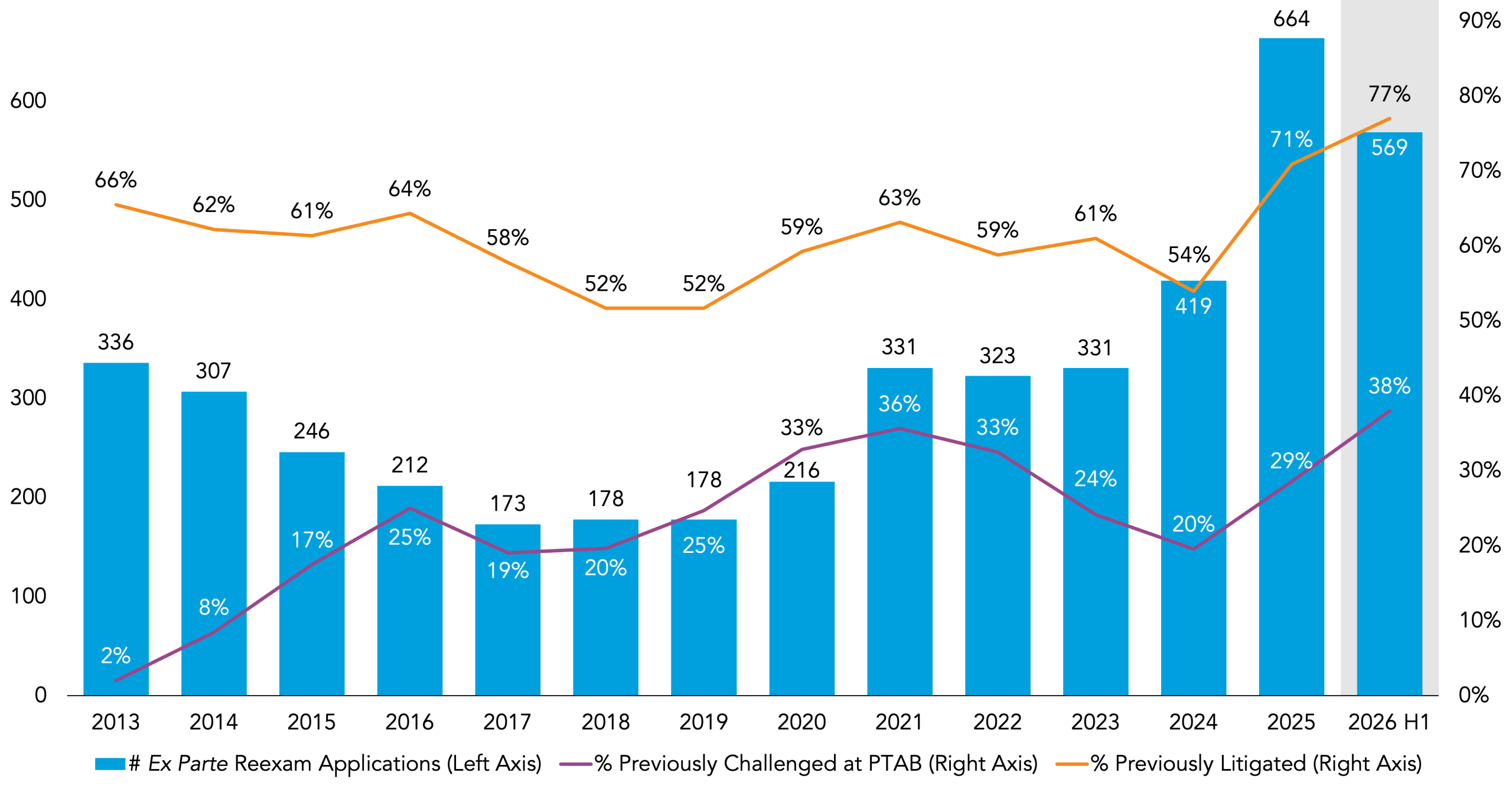
As RPX has previously noted, reexam filings have tended to climb in response to policy shifts that constrain IPR access: In 2020, the year that the Fintiv decision was designed as precedential, the number of requests for ex parte reexam increased by 21%, and then by 53% in 2021. While they held steady at about 330 requests per year in 2022 (the year Vidal issued the just-overturned guidance limiting NHK-Fintiv) and 2023, they surged by 27% in 2024 (following a decision by Vidal, in CommScope v. Dali Wireless, that limited the “compelling merits” exception then in effect under the 2022 guidance) and jumped further, by 58%, in 2025.
Reexams have climbed even higher so far this year: After 254 such requests were filed in Q1 2026, a 189% jump compared to that same quarter last year, Q2 saw 315 new filings, or 160% more than the year-ago quarter. Just halfway into the year, reexam filings are now just 14% lower than the entirety of 2025.
Data additionally indicate that the share of patents with reexam requests that have also been litigated in district court has continued to climb—reaching 77% in the first half of 2026, up from 71% in 2025 as a whole. Data also show that the number of patents for which defendants have also requested IPRs has kept rising, following a steady downward slide: After peaking at 36% in 2021 and decreasing to 33% in 2022, 24% in 2023, and 20% in 2024, this share jumped to 29% in 2025 and then to 38% in 1H 2026.
However, recent decisions indicate that reexams may no longer be quite as insulated from outcomes in other forums, thereby undercutting a key aspect of their appeal. In Q2, the USPTO began to reject requests for reexam under 35 U.S.C. § 325(d)—which allows discretionary denials of AIA reviews and reexams when the “same or substantially the same prior art or arguments previously were presented to the Office”—based on the prior discretionary denial of overlapping, parallel IPRs. Defendants may need to rethink the sequencing of their defensive strategies as a result, given the possibility that an IPR petition, even one not decided on the merits, could foreclose a potential reexam.
See RPX’s second-quarter review for more on recent changes at the USPTO, including their impact on PTAB filing levels and institution rates.