A Lloyd’s Coffee House for the 21st Century

February 9th, 2010

Warren Buffett once said, “Risk comes from not knowing what you’re doing.” He wasn’t talking about the dangers of portfolio manager inexperience; he was stressing the critical importance of information. For Buffet, the more you know, the more likely you are to make a reasonable, logical, low-risk decision. Conversely, without adequate information and market transparency it is impossible to make rational financial choices.

And yet that is what all of us in the patent market do on a daily basis. We accept unnecessary levels of risk simply because we don’t have established tools and venues for sharing industry information.

RPX recently hosted its first annual conference with a goal of changing the status quo and introducing transparency to our opaque industry. The conference brought together a broad cross-section of market participants and experts, and was a first step toward creating an environment and structures that would allow for easy sharing of data on patent pricing, acquisition activity, trends in IP litigation, developments in patent law and government policy, and more.

If history is a guide, the IP market has a good chance of successfully building such an environment. Three hundred years ago the international shipping industry was – like the patent market of today – in its infancy and facing the twin challenges of high risk and low information transparency.

Investors and underwriters that provided capital and risk management for commercial shippers were operating independently. There was little or no detailed information on shipping routes, sailing times, cargo manifests, weather, currents, reliability of captains and crew, or any of the myriad other data that would help make rational investment decisions. As a result, marine shipping and underwriting was an extremely volatile market.

But after Edward Lloyd opened a coffee house near the Thames in1687, things began to change. Lloyd’s quickly became the favored gathering place for ship owners, captains, marine underwriters, and insurance brokers. And just as quickly it became the central repository of and clearinghouse for the critical information they possessed.

Where underwriters and insurers had previously made financial decisions based on incomplete, inaccurate, or out-of-date information, they now had comprehensive and verifiable data on all aspects of commercial shipping. And where they had before made financial decisions unilaterally, they now had ready access to peers with whom they could collaborate, partner, and pool resources

And share risk. The greatest innovation to emerge from Lloyd’s wasn’t the expansion and greater transparency of information. It was how that information was used by market participants to rationalize the underwriting and insurance of vessels and cargo. The task of sailing from the Spice Islands with a cargo of nutmeg was just as difficult as it was before Lloyd’s was formed, but because investors and operators could efficiently share the risk of the voyage with multiple parties, they could focus on expanding their businesses without the risk of being financially ruined by a single unfortunate event.

Lloyd’s, of course, wasn’t an insurer, per se. It was a third party, an honest broker: a source of information to, and a disinterested enabler of, insurance underwriters. Without that innovation, insurance as we know it wouldn’t exist today.

Today the IP market is at the same early-stage inflection point the insurance industry was at 300 years ago. Our task now is to make our industry more efficient and less prone to risk, and building a 21st century equivalent of Lloyd’s coffee house is a good place to start.

Our market needs reliable sources of pricing data; of asset descriptions and analysis; of like-minded investors or buyers or sellers; of potential collaborators; of declared competitors. We need the level playing field and trusted trading venue that Lloyd’s provided. RPX is certainly committed to providing that 21st century version of Lloyd’s for the patent market, and other participants have also demonstrated a willingness to build structures to share information, mitigate risk, and rationalize the IP industry.

All of which is reason for optimism as our young, multi-billion dollar market continues to grow. To date we have all been operating largely in the dark, but as an industry we are beginning to control the risks in our financial decision making. We are starting to know what we’re doing. Continuing to expand that awareness will be crucial if our market is going to succeed in the long run.

Defensive Aggregation Complements Coming Patent Reform

December 17th, 2009

Robert C. Pozen recently assessed Congressional patent reform efforts in a New York Times op-ed piece. Mr. Pozen is a professor at Harvard as well as the chairman of MFS Investment Management, and in his piece he suggests some excellent changes in how patents are evaluated, issued and protected. His proposed reforms would indeed help “weed out low quality patent claims … and reward our best innovators”, but they would not address the most serious problem faced by both owners and users of intellectual property, which is the increasing number of lawsuits filed by non-practicing entities, or NPEs.

As Mr. Pozen notes, patent law needs to be reformed. Patents are the legal catalyst for technology innovation, and thus largely responsible the tremendous social and economic value created by that innovation. It is precisely this value that has created a thriving secondary market for patents.

NPEs have invested billions of dollars to purchase patents. Their business model is to solicit royalty payments from companies that make or use products or services incorporating technologies covered by the patents in question. By thus seeking to ‘monetize’, or extract the financial value embodied by their intangible assets, NPEs are doing what literally thousands of companies have done since the formation of this country. However, the fact that NPEs often use litigation as a tool in their monetization efforts has not endeared them to the many technology-driven companies that have been their targets, as patent litigation is costly and time-consuming for all involved.

Mr. Pozen does not suggest legislating away the ability to assert for NPEs or any third party to assert patent rights. Nor should he. Patents are legitimate property, and in America, property rights are legal bedrock.

The NPE approach to monetizing the value of intellectual property is nonetheless inefficient due to the excessively high transaction costs; and for many companies, it is a very expensive problem. The optimal remedy, however, is not a legal solution; it is a market solution. And efficient, market-based solutions are historically how industries have responded when companies collectively face operating risk.

For example, the merchant banks and insurance underwriters that emerged in the 17th and 18th century allowed brokers, land owners, manufacturers, traders and shippers to offset the significant financial risks – shared by all participants – of changing market conditions or catastrophic weather. Today, similar market-based approaches to addressing the NPE problem are taking shape, lead by RPX’s Defensive Patent Aggregation service. By combining our expertise in patent assessment with the economic resources of our fee-paying members to buy patents strategically and defensively, our service is able to keep patents out of the hands of NPEs who might otherwise assert them.

This approach enables a free and open market for intellectual property and ensures that patent owners can extract fair value for their asset without resorting to legal methods. And it provides an efficient, cost-effective way for companies to share the risks inherent in using technologies that are based on high-value intellectual property. It is a market solution to a legal problem, and one that – like Mr. Pozen’s suggested reforms – goes a long way toward protecting and nurturing the innovation that is the driving force of the American economy.

Making a Market: Defensive Patent Aggregation Turns One Year Old

December 2nd, 2009

A year ago, building a broad patent portfolio to serve as a defensive strategy was an innovative idea that generated more questions than answers. Could such a portfolio acquire enough patents – and enough of the right patents – to be effective? Would the ROI on avoiding legal action be financially compelling? Would enough members join to provide critical mass?

Twelve months later, the answer to those questions is very clearly “yes.” Leading technology companies dependent on IP have embraced the concept of preventing patent assertions before they begin. And this market acceptance has allowed the first large-scale defensive portfolio to grow quickly and achieve the scale needed to provide effective protection.

Since introducing its pioneering Defensive Patent Aggregation service on November 25, 2008, RPX Corporation has already acquired more than 1,000 US and foreign patents, licenses, and rights. The company is the first participant in the secondary market to buy patents for purely defensive purposes, and by doing so RPX has established two important new realities about the IP market.

First, patent owners are clearly willing and ready to sell their assets for a current fair-market valuation rather than go through a time-consuming and costly legal process with an uncertain financial outcome. Defensive aggregation has proven a very viable option in the secondary market.

Second – and most important – the rapid scaling of the Defensive Patent Aggregation service has demonstrated that a neutral central clearinghouse, acting on behalf of multiple beneficiaries can provide both broadly effective protection and compelling economies of scale. By supporting the defensive model with subscription fees (which are far lower than the typical annual cost of dealing with assertions), the pooled resources of RPX members are making a highly capital-intensive market possible while simultaneously reducing their own operating costs. They are also fundamentally changing how other companies facing NPE threats now view the problem – it has become a market solution rather than a legal solution.

Today, one year after launch, RPX has signed 20 members on four continents. It has invested $115 million to build its unrivaled defensive portfolio using its rapidly growing base of membership revenue and capital from investors Kleiner Perkins Caulfield & Byers, Charles River Ventures, and Index Ventures. (Charles River Ventures has described RPX as generating higher revenues in its first year of operations than any other early-stage startup in CRV’s history.) In 2010, RPX expects to achieve profitability on both a GAAP and cash basis while continuing its current rate of investment in its Defensive Patent Aggregation portfolio.

The market is still in its infancy and the defensive aggregation model is likely to continue to evolve. Other participants in the patent market have begun incorporating defense into their business models. Nonetheless, in twelve short months it has become clear that Defensive Patent Aggregation is an idea whose time has come and that the market has adopted this practical and sustainable approach to mitigating the risks of patent litigation.

Cost-Avoidance Key to Exceptional ROI from Defensive Aggregation

October 28th, 2009

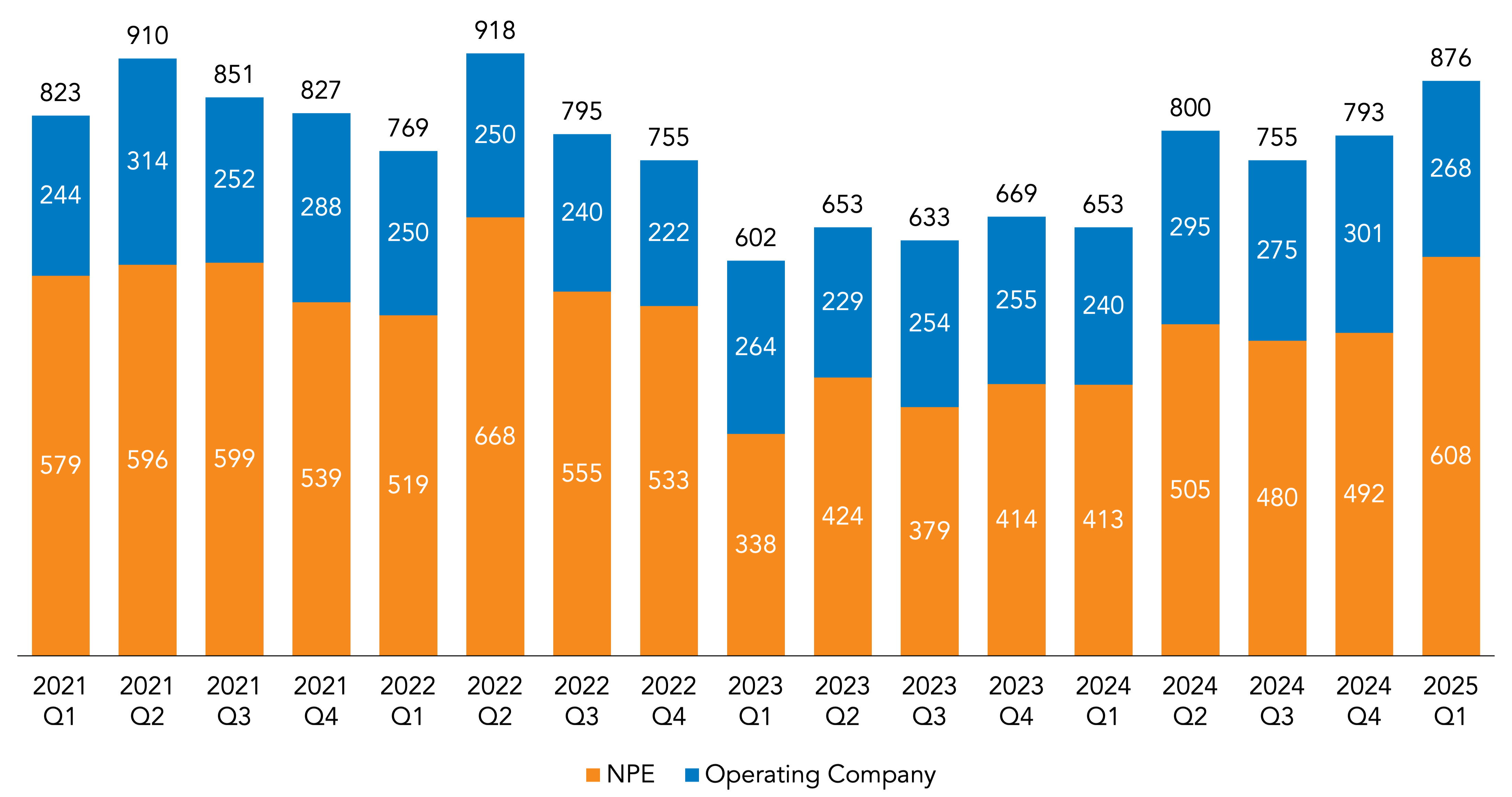
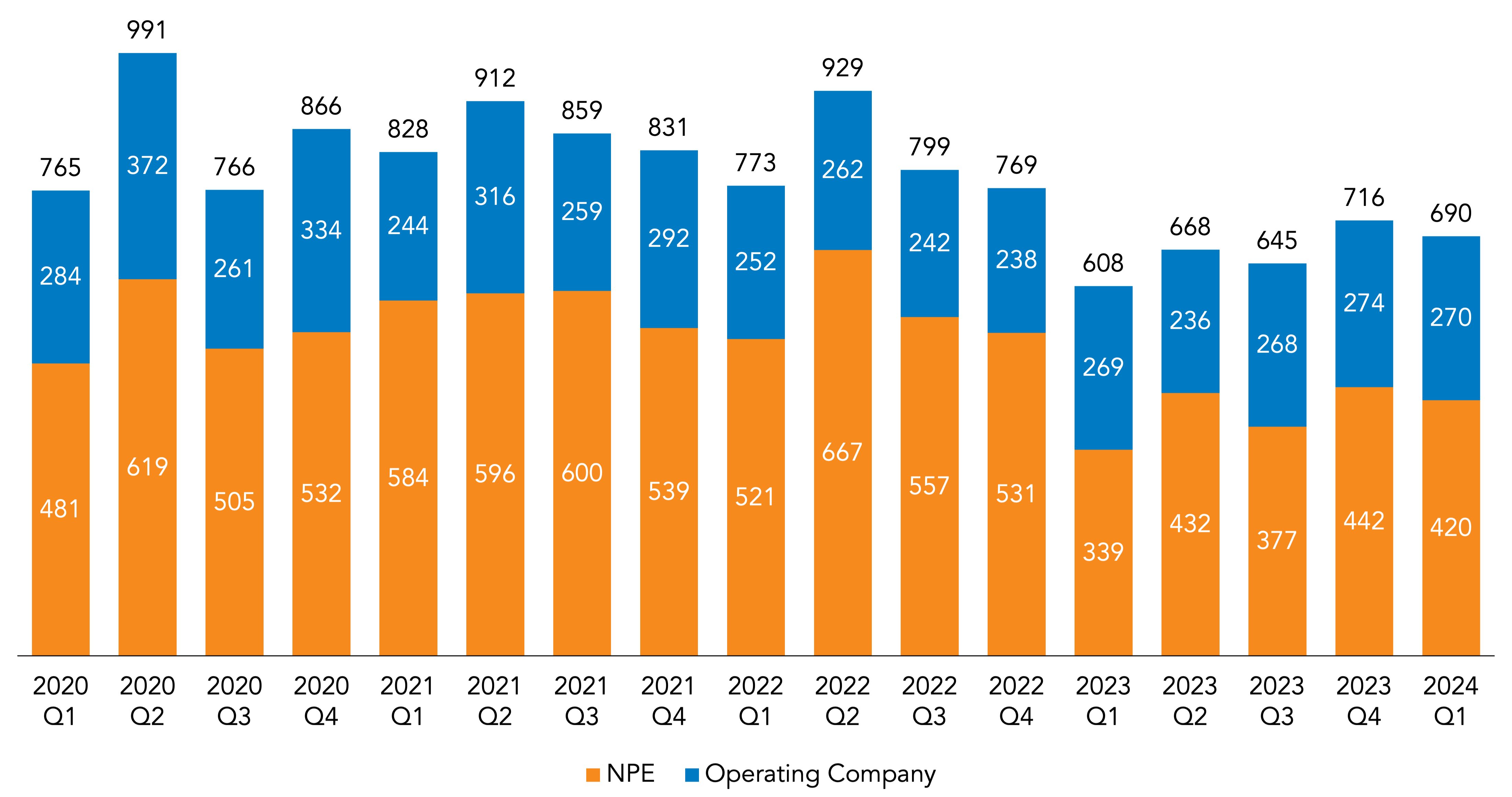
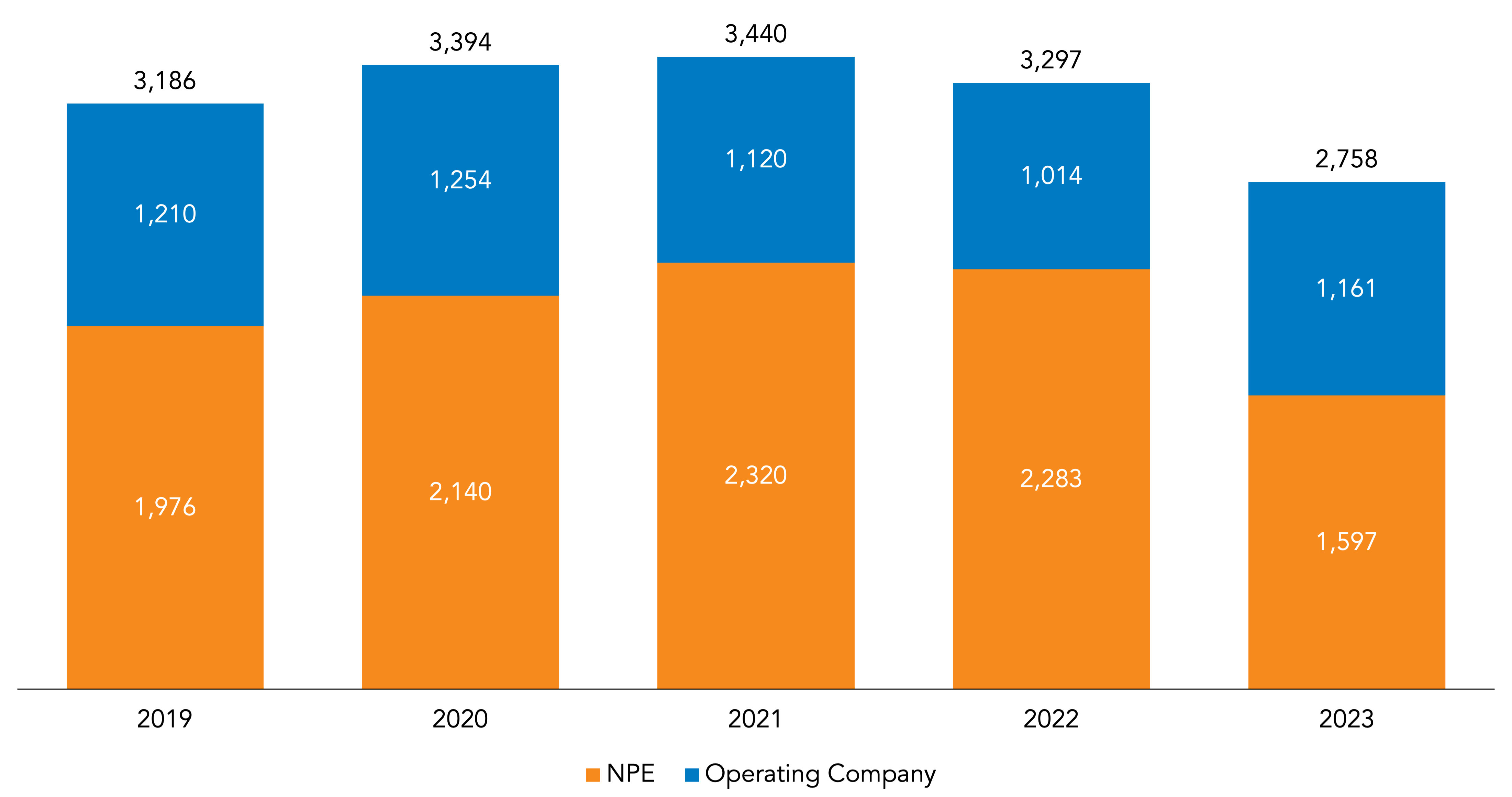
As our previous post illustrated, per-case costs of defending against patent assertions are going up. Further compounding the overall problem is the fact that the total number of assertions is also on the rise, creating even more financial risk for IP-driven companies. Data from Patent Freedom show that through August 31, 2009, 343 patent cases were filed in the United States. This figure for the first eight months of 2009 already almost matches the 359 cases filed in all of 2008, suggesting that the cumulative volume of NPE cases in 2009 could grow 50% over 2008. Notably, in the 2009 cases, 19.5% involved NPEs, up from 12.8% of the cases in 2008. However, for companies in the technology sector, the data is dramatically worse. RPX analyzed 60 U.S. and Asian technology companies and concluded that to date in 2009 more than 80% of patent assertions against these companies stemmed from non-practicing entities. These statistics suggest that the financial logic of defensive aggregation has become increasingly compelling.

For example, consider a mid-sized company with $825 million in annual operating income. If the company is named in a typical patent assertion with $5 million in damages at risk, it might be one of five defendants. Based on data recently published by the American Intellectual Property Law Association (AIPLA), this company’s legal costs through discovery alone would be approximately $1.8 million, with total costs likely to exceed $3 million. Note that these estimated costs are not for high-end, complex assertions; they relate to what AIPLA’s respondents consider an ‘average’ patent-infringement action, and do not include settlements.

To join RPX’s defensive patent aggregation, a firm of this size would pay $2.5 million per year, meaning the cost of membership would be well under the legal fees saved by avoiding two average assertions that went past discovery, or total costs of just one complaint.

For small firms, of course, a patent assertion can be a death blow. The hundreds of thousands of dollars needed just to pay for discovery could easily represent fully two or three months’ burn rate for an early-stage software company. But for a firm with operating income below $5 million – including startups that have no revenue, let alone operating income – the $35,000 annual cost to join RPX is comparable to the Director’s and Officer’s insurance that is considered indispensible for venture-backed companies, even though the likelihood and consequences of patent litigation are greater and more severe than most of the events covered by D&O insurance.

For larger firms, the numbers are especially telling. A large technology firm with $5 billion or more in operating income would pay $4.9 million in annual membership to RPX. Such firms are also usually named in assertions with larger potential damages that would exceed $25 million, and they are also named much more frequently. The world’s leading consumer electronics firms are asserted 10 to 12 times per year on average, according to AIPLA. Such a firm’s RPX fee is ‘paid for’ by avoiding just the discovery phase of only two assertions; the reduced risk of large damages awards is just another benefit of membership.

Defensive patent aggregation makes financial sense for companies that recognize and understand the true all-in costs of patent assertions, and have the internal discipline to calculate investment ROIs based on avoided costs as well as potential revenues. To update Benjamin Franklin’s dictum, especially appropriate in today’s flat-growth economic environment: “$5 million saved is $5 million earned”.

New Litigation-Cost Data Underscores Financial Logic of Defensive Patent Aggregation

October 11th, 2009

A weak worldwide economy may be driving down prices in some sectors, but it hasn’t dampened the price of patent litigation. New figures compiled by the American Intellectual Property Law Association (AIPLA) show an upward trend in legal expenses associated with responding to and defending against patent assertion.

After surveying approximately 430 attorneys involved in patent assertions with between $1 million and $25 million in potential damages at risk, the AIPLA determined that, for a single defendant in a case with only one patent at issue, legal costs through the discovery phase alone are averaging $1.8 million in 2009, up from $1.6 million in 2007. Total costs for such cases - including all outside counsel, paralegals, travel, analytics, expert witnesses, etc. - are averaging $3.1 million in 2009, almost 20% higher than the average of $2.6 million two years ago.

The numbers are even more striking for litigations with greater than $25 million in damages at risk. A survey of approximately 400 respondents showed that during 2009 average legal costs through discovery are averaging $3.7 million, and all-inclusive costs to fight such cases to conclusion exceed $6.2 million, up from $3.3 million and $5.5 million, respectively, in 2007.

Many in-house litigators focus more on license fees than on legal costs, in part because the latter are incurred via multiple comparatively small legal bills, versus single ‘lump sum’ payments to plaintiffs. However, as this data illustrates, unless a defendant’s counsel is highly confident that it will resolve the litigation well before discovery, the defendant should expect to spend anywhere from $2 million to over $6 million in total legal costs- in many cases more than the actual cost of the license.

The “Free Rider” Fallacy

September 15th, 2009

As the practice of defensive patent aggregation continues to gain traction in the IP market, some observers have suggested that there is a flaw in the RPX business model: the apparent opportunity for non-member operating companies to “free ride” on the protection against assertion and litigation that is being paid for by members of the buying group. But the free ride is a fallacy; the protection doesn’t really exist.

The error that free riders would make is assuming that any patent purchased into the defensive portfolio will provide broad, ongoing, and unlimited protection against assertion of rights. This is not always the case. RPX often makes purchases with clearly delineated scope of ownership – partial patent rights or sub-licenses rather than entire patents – that is customized to the specific defensive needs of members.

RPX may also purchase a full patent or family of patents, but then quickly sell off rights to key aspects of the IP not germane to members’ operation. Similarly RPX may choose to sell entire patents back into the market after a limited holding period. This is part of the strategy at RPX since members retain a perpetual license to any patent that is purchased during their time as members. Such ongoing protection would not benefit any company choosing to free ride.

In addition to being a flawed method for reducing the risk of NPE assertion, free riding also precludes companies from gaining the broader strategic benefits of membership. RPX has deep knowledge of the IP market, and can offer insight on valuations, pricing trends, visibility on high-value or high-risk assets coming into play. The competitive edge that comes from that kind of knowledge is available only to members working closely with the aggregation team.

It is also worth noting that beyond the demonstrable disadvantages of free riding for the companies that risk it, there are broader and equally compelling negative effects that would result if free riding were to become commonplace. Defensive aggregation is a new and potentially game-changing way to limit or eliminate the threat of NPE-driven legal attacks. The foundation of building broad-based and broadly effective defensive patent portfolios is broad participation by operating companies.

As has already become evident, even a limited number of participating members can generate sufficient capital to take many actionable patents out of circulation. But the number of such patents is large and continuously growing. It will require a correspondingly large pool of money to purchase patents on the scale needed to succeed.

Free riding limits the number of participants in defensive aggregation and the amount of capital that can be deployed by RPX and other aggregators. Membership fees from large, market-leading technology companies have already made defensive aggregation a potent tactic to limit the scope and negative impact of NPE assertions. But to fundamentally change the dynamics of how IP assets are bought, sold, and used (or not used) as legal weapons, a broader collection of large and small fee-paying members will be needed for aggregators to have the economic resources that can clearly and consistently dominate acquisitions activity in the IP market.

Do Early-Stage Companies Need a Patent Defense Strategy?

August 27th, 2009

Start-up companies often spend years in relative obscurity developing and perfecting technology-based products and services. During those early years of angel financing or Series A venture funding, these companies rarely need protection against NPE assertions. Not only are they too small to attract notice, but few have the financial resources to generate sufficient damages from a successful legal action.

For those companies that hit the inflection point where product potential becomes realizable market opportunity, NPEs are a near certainty. Before a company reaches this stage – when venture and/or strategic partners begin to pour in new growth capital, the product or service begins to generate real revenues, and the company begins to get noticed by customers, competitors, and NPEs – management should establish patent defense as a critical part of its core operating strategy.

Having a well-considered patent defense program is important for several reasons. First, any kind of legal encumbrance is a serious obstacle for a company planning to close a round of financing. But even if potential investors are satisfied that the company’s legal position is strong, consider the heightened financial risks for such a company. On average, B-round product-launch financing for a venture-backed company during 2008 raised $11.1 million – capital earmarked for establishing quality assurance and fulfillment processes, preparing marketing strategies, and building a sales organization. The monthly burn rate for such an emerging company – for example, a software developer with 40 to 50 employees – in the run up to product launch would be approximately $500,000, and possibly twice that for a hardware or device manufacturer with production infrastructure. If such a company suddenly had to carry legal costs of $50,000 per month to defend against an assertion, the burn rate would jump and the path to profitability would be slowed – especially problematic in the current tight financing environment. Management attention would also be distracted from key pre-commercialization activities just when it is needed most.

To mitigate this risk, start-up companies have several choices. They can do nothing, which is a common approach, but one that can have severe long-term consequences. More active strategies include adding in-house legal expertise, either through bolstering their management – a high fixed cost when capital efficiency is critical – or by relying on their boards, though IP legal skill is not often a core competence of venture capital partners. Finally, emerging tech companies can pursue preemptive defensive strategies, such as purchasing patent rights in the open market or joining a defensive aggregator.

The cost/benefit impact of each approach will vary from company to company and industry to industry, but CEOs and their boards should explicitly address which strategy makes the most sense. With NPE activity growing wider, start-ups are not immune to patent assertion and their business plans should evolve to reflect this potential threat to their near-term survival and long-term success.

Real Drawback to NPE Model is Inefficiency, not Greed

August 13th, 2009

NPEs are often portrayed as predatory and opportunistic manipulators of intellectual property. But to do so is to confuse the means with the end. NPEs have provided one of the few ways for creators of intellectual property to monetize their assets. Most inventors or owners of intellectual property who feel their patents are being infringed by a corporation are too small to make a compelling case for licensing and insufficiently capitalized to mount legal action. Their only viable alternative has been to “sell” their patents to NPEs, who then take on the cost and risk of monetizing those intellectual property assets through the courts.

While NPEs’ willingness to purchase patents has helped develop a much-needed market for otherwise illiquid assets – a highly desirable end for any economic activity – the NPEs’ means of doing so is highly inefficient.

The source of that inefficiency, of course, is the legal system. It takes time and energy for NPEs to prepare and document an assertion; even more to prepare and execute a litigation. The risk of losing the case must also be priced into any action, and inventors and NPEs share this risk – which is why the purchase price typically paid by an NPE for patents is relatively modest, with a larger payout for the inventor waiting at the end of the hoped-for successful legal action. Inventors also often need to invest a significant amount of time traveling to and sitting through depositions and other legal discovery with no guarantee of a positive trial outcome. Lastly, legal costs often amount to more than half of the cost incurred by defendants, further decreasing the amount of money ultimately going to the inventor.

A more efficient way to create liquidity for patent owners is to remove the need for legal filings, discovery, assertion, and/or trial from the process. Instead of generating capital to pay inventors through a single, large legal award, defensive patent aggregators generate capital by collecting funds from multiple, relatively small contributions that come from precisely those companies that would otherwise face financial exposure from patent assertion.

Aggregators purchasing patents defensively can thus offer fair-market value to inventors without a back-end payment based on litigation that is risky and costly for both plaintiff and defendant. It is a business model built on the possibility that acquired patents could have been asserted rather than the active threat of same. As such it is a far more rational and efficient way to price and monetize this important asset class.

NPE Activity on the Rise as Economy Slumps

July 30th, 2009

A post earlier this year (“The Effect of an Economic Downturn on NPE Litigation” 1/27/09) cited historical data to suggest that NPE patent litigation increases in a deteriorating economic environment. Based on NPE activity through the first half of 2009, it appears that history is indeed repeating itself.

According to Patent Freedom statistics, in 2008 there were 2,806 patent cases in the United States.  Of these, 359 – or 12.8% – were NPE-driven suits.  Looking at PACER and Lexis/Nexis data through June 30 of this year, we see that while overall patent litigation activity has actually slowed, the incidence of NPE cases is higher.  There were only 1,318 patent cases at the halfway point of 2009, but of these 224 were NPE cases (a 25% increase in activity).  Fully 17% of the US patent cases filed in the first six months this year were NPE-driven.

With general economic recovery still a work in progress and world markets remaining largely soft and unstable, this data suggests that NPE activity will continue to rise at an above-average rate through at least the end of 2009 and into early 2010.

“Fight Hard” as a Patent Defense Strategy

April 9th, 2009

Many companies adopt ‘never settle, fight everything’ strategies when faced with NPE patent assertions. The rationale, generally borrowed from mass tort defense, is that by vigorously defending every attempted assertion via litigation, even those that could be settled for less than the cost of litigation, a company can establish a reputation as a ”hard target” and thus deter future NPE assertions.  But how effective will the fight hard strategy be when applied to NPE assertions, and is it a comprehensive strategy?

Before turning to the NPE issue, it’s worth asking how well the strategy worked against other mass torts. The most widely cited example is asbestos litigation.  While some observers argue that the fight hard approach averted a great deal of litigation, others point to the fact that asbestos litigation has bankrupted virtually every U.S. company that manufactured as evidence that the strategy may not have worked as planned.

An important factor underlying the ‘fight everything’ strategy with mass torts was the commonality of fact patterns from case to case.  Defendants believed that winning one case would mean winning the next, and when each case rides on the same basic questions this may be true. However, the unique nature of every patent case deprives defendants of this benefit. To date, there is no evidence that the wider use of the fight hard strategy has had any effect in countering the rise of NPE litigation. NPE litigation has continued to increase during the first three months of 2009 with NPE cases composing 13.3% of all patent infringement cases up from 12.8% in 2008.*  The implication may be that the fight hard strategy can be an effective tactic to deter certain plaintiffs, but should be used thoughtfully depending on the merits of the case and the nature of the specific plaintiff.  Since not every plaintiff will be deterred by this approach, companies may need to consider additional defensive tactics in their overall strategy to combat NPEs.

One such alternative strategy that can help avert NPE litigation is to proactively purchase patents that are at risk of being sold to NPEs.  Many NPEs are well-funded to acquire assets to assert, and they often find these patents on the open market, in some cases only weeks prior to asserting them.  Purchasing patents before they reach an NPE can thus be an effective tactic to reduce NPE litigation, and may be far less expensive than the cost of litigation.

*Sources: LexisNexis CourtLink 1/1/09 – YTD and Patent Freedom.